

Property Management Taxes In Florida
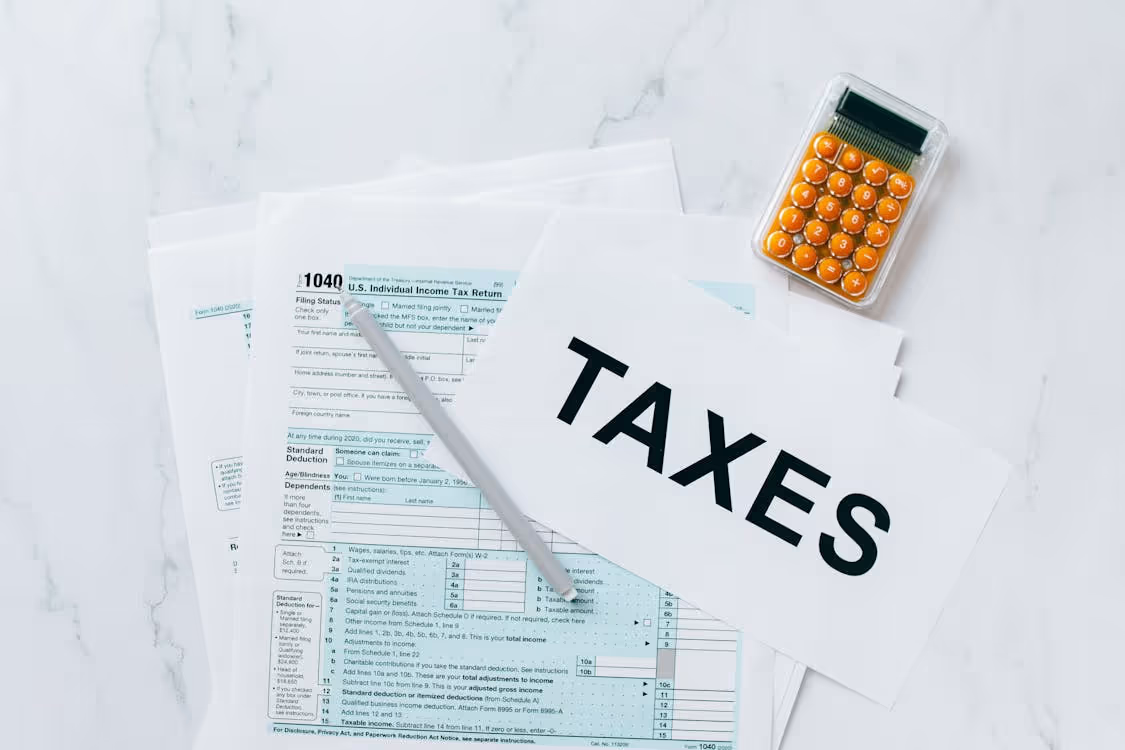
Florida has no personal income tax, which is often where the conversation about Florida rental taxes stops. For a management company it is where it starts: the taxes that actually apply here are sales tax on the right kind of rental, transient and tourist development taxes, reemployment tax if you have employees, and the county tangible personal property tax. Getting the sales tax question wrong in either direction, collecting when you should not or failing to when you must, is the common expensive mistake.
Everything below is sourced to Florida statutes, Department of Revenue guidance, and the IRS. Rates and thresholds move, so confirm the current figure against the citation before you rely on it.
No State Income Tax, But Rental Income Is Still Taxed
Florida imposes no personal income tax. The Florida Constitution bars the state from taxing the income of natural persons who are residents or citizens, and the Legislature has written that mandate into the corporate income tax code. For a property management company or a rental owner, this means Florida takes nothing off the top of rental profit at the individual level, but it changes nothing federally. Rental income is still fully taxable by the IRS and is still reported on Schedule E of Form 1040.
- The Florida Constitution provides that no tax upon the income of natural persons who are residents or citizens of the state shall be levied by the state, or under its authority, in excess of the aggregate of amounts which may be allowed to be credited upon or deducted from any similar tax levied by the United States. Because no federal credit for state income tax exists, the practical effect is that Florida levies no personal income tax. (Fla. Const. art. VII, s. 5(a))
- Article VII, Section 5 of the Florida Constitution was added by H.J.R. 7-B, 1971, and adopted in 1971, so the prohibition on personal income taxation is a long-standing constitutional provision rather than a statute the Legislature can change by ordinary bill. (Fla. Const. art. VII, s. 5, History note)
- Florida's corporate income tax code states its own legislative intent as construing the code to avoid conflict with the mandate in Section 5, Article VII of the State Constitution that no income tax be levied upon natural persons who are residents and citizens of this state. (Fla. Stat. s. 220.02)
- Florida's income tax is directed at artificial entities, meaning corporations, organizations, associations and other artificial entities that derive attributes not available to natural persons such as perpetual life, transferable ownership represented by shares, and limited liability for all owners. It is not directed at natural persons conducting business individually or in partnerships, limited liability companies classified as partnerships for federal purposes, estates, or testamentary trusts. (Fla. Stat. s. 220.02)
- Sole proprietors, individuals, estates of decedents and testamentary trusts are exempt and do not have to file a Florida corporate income tax return. (Business Owner's Guide for the Major Florida Taxes, GT-300015, Florida Corporate Income Tax)
- Rental real estate income and loss is reported federally on Schedule E (Form 1040), Supplemental Income and Loss, which covers rental real estate, royalties, partnerships, S corporations, estates, trusts and residual interests in REMICs. The absence of a Florida personal income tax does not remove this federal reporting obligation. (IRS, About Schedule E (Form 1040))
- IRS Publication 527, Residential Rental Property, is the controlling federal guidance on reporting rental income and expenses, including depreciation, for owners of residential rental property. (IRS Publication 527 (2025), Residential Rental Property)
Sales Tax On Rent: What Applies And What Does Not
This is the Florida topic most often reported incorrectly, because the law changed. Florida used to charge state sales tax on commercial rent, and that tax was repealed outright effective October 1, 2025. Long-term residential rent was never subject to it. What remains taxable is short-term or transient occupancy of six months or less, taxed at 6 percent under a separate statute. Management companies should treat commercial rent, long-term residential rent, and transient rent as three distinct categories.
- Effective October 1, 2025, the state sales tax imposed on rent or license fees for the use of real property (commercial rentals) under section 212.031, Florida Statutes, is repealed. No state sales tax or discretionary sales surtax applies to rent or license fees for rental or occupancy periods beginning on or after October 1, 2025. Examples subject to the repeal include rentals of commercial office or retail space, warehouses, and self-storage units. (TIP No. 25A01-04, issued July 24, 2025; Fla. Stat. s. 212.031)
- The repeal covers both the state sales tax and any associated discretionary sales surtax. The Department states plainly that discretionary sales surtax will not still apply after October 1, 2025. (TIP No. 25A01-04, Questions and Answers, item 7)
- Sales tax and any applicable discretionary sales surtax continue to apply to rent or license fee payments for rental or occupancy periods through September 2025, even if payment is made on or after October 1, 2025. The Department's example is that a tenant paying August 2025 rent in October still owes the 2 percent state sales tax plus any applicable surtax. Delayed payment of rent for taxable rental periods does not avoid tax. (TIP No. 25A01-04, Excluded from Repeal and Q&A item 1)
- The repeal did not touch sales tax imposed under section 212.03, Florida Statutes, which continues to apply to rentals or leases of living, sleeping, or housekeeping accommodations for six months or less (transient rentals), parking or storage spaces for motor vehicles in parking lots or garages, docking or storage spaces for boats in boat docks or marinas, and tie-down or storage space for aircraft at airports. (TIP No. 25A01-04, Excluded from Repeal; Fla. Stat. s. 212.03)
- Florida's 6 percent state sales tax, plus any applicable discretionary sales surtax, applies to rental charges or room rates for the right to use or occupy living quarters or sleeping or housekeeping accommodations for rental periods of six months or less. Examples include hotel and motel rooms, condominium units, timeshare resort units, single-family homes, apartments or units in multiple unit structures, mobile homes, beach or vacation houses, campground sites, and trailer or RV parks. (Sales and Use Tax on Rental of Living or Sleeping Accommodations, GT-800034 (R. 10/25), What is Taxable)
- Long-term residential rent is exempt. Rental charges or room rates paid by a person who entered into a bona fide written lease for continuous residence for a period longer than six months are exempt. (Sales and Use Tax on Rental of Living or Sleeping Accommodations, GT-800034 (R. 10/25), What is Exempt; Fla. Stat. s. 212.03(1)(a))
- Where there is no written lease, the exemption can still be reached through occupancy. When a person has continuously resided at one transient accommodation for a period longer than six months and has paid the applicable tax on the rental charges for those first six months, the rental charges paid by that person are exempt on the seventh month and thereafter so long as that person continuously resides at that accommodation. (Sales and Use Tax on Rental of Living or Sleeping Accommodations, GT-800034 (R. 10/25), What is Exempt)
- Section 212.03, Florida Statutes, is titled 'Transient rentals tax; rate, procedure, enforcement, exemptions' and imposes tax at 6 percent of and on the total rental charged for living quarters or sleeping or housekeeping accommodations, reaching hotels, apartment houses, roominghouses, tourist camps, trailer camps, mobile home parks, recreational vehicle parks, condominiums and timeshare resorts. The statute also exempts the rental of living accommodations in any building or group of buildings intended primarily for lease or rent to persons as their permanent or principal place of residence. (Fla. Stat. s. 212.03)
The distinction that matters day to day: a long-term residential lease is not subject to sales tax, a rental of six months or less is, and the separate state tax on commercial rent was repealed outright effective October 1, 2025. Older guidance still circulating online quotes a live commercial rent rate of 2 percent or higher; that is no longer correct for occupancy periods beginning on or after that date.
Transient Rental And Tourist Development Taxes
Short-term rental operators face a two-layer tax. The 6 percent state sales tax plus discretionary sales surtax always goes to the Florida Department of Revenue. On top of that, counties and some cities impose local option transient rental taxes, commonly the tourist development tax, and in most counties that layer is self-administered and remitted directly to the county rather than to the state. Every person renting transient accommodations must register, and a management company collecting rent on an owner's behalf must register too.
- Florida counties may impose local option taxes on transient rentals including the tourist development tax, convention development tax, tourist impact tax and municipal resort tax. These local option transient rental taxes are in addition to the 6 percent state sales tax and any applicable discretionary sales surtax. (Local Option Transient Rental Tax Rates, Form DR-15TDT (R. 03/25))
- Local option transient rental tax rates vary by county and currently range from 0.0 percent in counties such as Calhoun, Lafayette and Liberty up to 6.0 percent in counties such as Broward, Duval, Hillsborough and Manatee. Form DR-15TDT lists the rate for every county and whether it is collected by the county or by the Department. (Local Option Transient Rental Tax Rates, Form DR-15TDT (R. 03/25))
- Most counties self-administer the transient rental tax. In those counties the transient rental tax is reported and remitted directly to the county, but the state sales tax and any applicable surtax are reported and remitted to the Florida Department of Revenue. Transient rental tax imposed in counties that do not self-administer is reported and remitted to the Department along with the state sales tax. (Sales and Use Tax on Rental of Living or Sleeping Accommodations, GT-800034 (R. 10/25))
- Every person, as defined in section 212.02, Florida Statutes, who rents, leases, lets, or grants a license to use transient accommodations is required to register with the Department to collect, report and remit tax. Each place of business where transient accommodations are provided must be separately registered. Any person who receives rent or license fees for transient accommodations on behalf of the owner or lessor is also required to register, though this does not apply to employees of an owner or lessor. (Sales and Use Tax on Rental of Living or Sleeping Accommodations, GT-800034 (R. 10/25), Who Must Register to Collect Tax)
- Management companies renting or leasing transient accommodations and collecting rent on behalf of owners may use collective registration. The Application for Collective Registration of Living or Sleeping Accommodations (Form DR-1C) lets an agent register multiple transient rental accommodations for one or more owners. A sales and use tax Certificate of Registration (Form DR-11) is issued to each property owner and mailed to the agent or management company, and a letter with the certificate number and the agent's name is mailed to the property owner. (Sales and Use Tax on Rental of Living or Sleeping Accommodations, GT-800034 (R. 10/25), Collective Registration)
- Sales tax and surtax due on transient rentals are reported on Line D of the Sales and Use Tax Return (Form DR-15). Local option transient rental taxes are included on Line D only when the tax is to be reported and remitted to the Florida Department of Revenue. The $5,000 discretionary sales surtax limitation does not apply to charges for transient rentals. (Sales and Use Tax on Rental of Living or Sleeping Accommodations, GT-800034 (R. 10/25), How to Report Tax)
- Returns and payments are due on the 1st and late after the 20th day of the month following each reporting period, and Florida law requires a return to be filed even when no sales and use tax is owed. Filing and paying electronically and on time earns a collection allowance of 2.5 percent (0.025) of the first $1,200 of tax due, not to exceed $30. (Sales and Use Tax on Rental of Living or Sleeping Accommodations, GT-800034 (R. 10/25), Filing and Paying Tax)
- Additional exemptions apply beyond the six-month rule. Rental charges paid by a full-time student enrolled in an institution offering postsecondary education are exempt where the student provides a written statement from an institution official, and rental charges paid by active-duty military personnel present in the community under official orders are exempt where the member provides a copy of the orders or an overflow certificate. Rule 12A-1.061, Florida Administrative Code, governs rentals, leases and licenses to use transient accommodations. (Sales and Use Tax on Rental of Living or Sleeping Accommodations, GT-800034 (R. 10/25); Rule 12A-1.061, F.A.C.)
Tangible Personal Property Tax
Florida has no state ad valorem tax on tangible personal property, but counties do assess it, and it catches property managers twice: the furnishings and appliances in furnished or short-term rentals, and the office equipment in the management company itself. The return is Form DR-405, filed with the county property appraiser by April 1. Filing on time is what unlocks the exemption of up to $25,000 in assessed value, and the penalties for skipping it are steep.
- Tangible personal property means all goods, chattels, and other articles of value (excluding some vehicular items) capable of manual possession and whose chief value is intrinsic to the article itself. (Fla. Stat. s. 192.001(11)(d))
- Anyone who has a proprietorship, partnership, or corporation, is a self-employed agent or contractor, or leases, lends or rents property on January 1 must file a tangible personal property return with the county property appraiser by April 1 each year using Form DR-405. (Fla. Stat. s. 193.062; Form DR-405)
- Filing the tangible personal property return by April 1 makes the filer eligible for a property tax exemption of up to $25,000 of assessed value. (Fla. Stat. s. 196.183)
- If the initial tangible personal property is valued at or below $25,000, the owner may qualify for a waiver of the filing requirement in future years so long as the value remains at or below $25,000. The property appraiser notifies qualifying taxpayers by February 1. (Fla. Stat. s. 196.183)
- Failure to file results in a penalty of 25 percent of the total tax levied against the property. Filing late results in a penalty of 5 percent of the total tax levied for each year, each month, and part of a month that a return is late, not to exceed 25 percent of the total tax. An incomplete return carries a penalty of 15 percent of the tax attributable to the omitted property. (Fla. Stat. s. 193.072)
- The return itself is Form DR-405, Tangible Personal Property Tax Return, a confidential return prescribed by the Florida Department of Revenue and filed with the county property appraiser. (Form DR-405 (R. 01/18))
- The tangible personal property tax is a local rather than a state tax. The Florida Constitution provides that no state ad valorem taxes shall be levied upon real estate or tangible personal property, which is why the return goes to the county property appraiser and the bill comes from the county. (Fla. Const. art. VII, s. 1(a))
Reemployment Tax For Companies With Employees
Florida calls its state unemployment tax the reemployment tax, and it is paid entirely by the employer. Only the first $7,000 of each employee's wages in a calendar year is taxable. New employers start at 2.7 percent and stay there until they have reported for ten quarters, after which an experience rate applies within a floor of 0.1 percent and a ceiling of 5.4 percent. A property management company with even one employee for a day in twenty weeks can trigger liability.
- Only the first $7,000 of wages paid to each employee by their employer in a calendar year is taxable. Any wages paid over $7,000 for the calendar year are excess wages and are not subject to tax. Reemployment tax is paid by employers as a cost of doing business, workers pay no portion of it, and employers may not make payroll deductions for the tax. (Business Owner's Guide for the Major Florida Taxes, GT-300015, Florida Reemployment Tax)
- The initial tax rate for new employers is 2.7 percent applied to the first $7,000 in wages paid to each employee during a calendar year, and that initial rate applies until the employer has reported for 10 quarters. (Business Owner's Guide for the Major Florida Taxes, GT-300015, Your Reemployment Tax Rate)
- The maximum tax rate allowed by law is 5.4 percent, except for employers participating in the Short Time Compensation Program, and by law an employer's tax rate may not be lower than 0.1 percent. Rate notices are mailed to all contributing employers each year, and an employer may appeal its tax rate within 20 days from the date of notification. (Business Owner's Guide for the Major Florida Taxes, GT-300015, Your Reemployment Tax Rate)
- For 2026, effective January 1, 2026, the minimum rate is 0.0010 (0.1 percent) or $7 per employee and the maximum rate is 0.0540 (5.4 percent) or $378 per employee, applied against the taxable wage base. (Florida Department of Revenue, Reemployment Tax Rate Information)
- An employer becomes liable for reemployment tax when it meets any of several conditions, including being liable for federal unemployment tax, having a quarterly payroll of $1,500 or more, or having one or more employees for a day (or portion of a day) during any 20 weeks in a calendar year. (Business Owner's Guide for the Major Florida Taxes, GT-300015, Employers Liable for Reemployment Tax)
- Employers register with the Florida Department of Revenue to report and pay Florida reemployment tax, either online through the Department's registration site or by submitting a paper Florida Business Tax Application (Form DR-1). Employers liable for reemployment tax must also display the poster To Employees (Form RT-83) where all employees can see it. (Business Owner's Guide for the Major Florida Taxes, GT-300015, Registration for Reemployment Tax)
- Employers must file an Employer's Quarterly Report (Form RT-6) each calendar quarter to report wage data and pay tax due. The report is due the first day of the month following the end of each calendar quarter and is timely if filed electronically, postmarked, or delivered on or before the last day of that month, giving deadlines of April 30, July 31, October 31 and January 31. A report must be filed each quarter even if no wages were paid and no tax is owed. (Business Owner's Guide for the Major Florida Taxes, GT-300015, File and Pay Reemployment Tax)
- Employers who employed 10 or more employees in any calendar quarter between July 1 and June 30 (the state fiscal year) must file reports and pay tax electronically the next calendar year. Separately, federal and state law require Florida employers to report all new and rehired employees and independent contractors who will earn more than $600 per calendar year, and section 448.095, Florida Statutes, requires employers to verify each new employee's employment eligibility within three business days after the first day of work, with private employers of 25 or more employees required to use E-Verify. (Business Owner's Guide for the Major Florida Taxes, GT-300015, Electronic Payment Requirements, Florida New Hire Reporting Requirement, and Employer E-Verify Certification; Fla. Stat. s. 448.095)
Registration And Recordkeeping
A management company that handles short-term rentals, or that collects rent on an owner's behalf, must register with the Florida Department of Revenue before it begins doing business, and must register each Florida business location. Registration produces a Certificate of Registration (Form DR-11) that has to be displayed, and an Annual Resale Certificate (Form DR-13). Records supporting every transaction must be kept for at least three years, and returns must be filed for every reporting period even when no tax is due.
- A business that plans to engage in an activity subject to sales and use tax must register to collect, report and remit or pay Florida sales and use tax before it begins conducting business in Florida. Taxable business activity expressly includes leasing, licensing, or renting real property and leasing, licensing, or renting living, sleeping, or housekeeping accommodations. (Business Owner's Guide for the Major Florida Taxes, GT-300015, Registering a Florida Business)
- Registration is done online through the Department's website or by completing the paper Florida Business Tax Application (Form DR-1). Each Florida business location must be registered, except for communications services tax. (Business Owner's Guide for the Major Florida Taxes, GT-300015, Registering a Florida Business)
- After registering for sales and use tax, the Department mails a Certificate of Registration (Form DR-11), a Florida Annual Resale Certificate for Sales Tax (Form DR-13), an initial supply of returns (Form DR-15 or DR-15EZ) unless filing electronically, and Discretionary Sales Surtax Information (Form DR-15DSS). (Business Owner's Guide for the Major Florida Taxes, GT-300015, Registering a Florida Business)
- The Certificate of Registration (Form DR-11) authorizes the business to conduct business at the address shown and must be displayed in a visible place at the business location. The Florida Annual Resale Certificate (Form DR-13) is used only for tax-exempt purchases or rentals of property or services intended for resale or re-rent, and is not for buying office equipment, computers or other supplies used by the business. (Business Owner's Guide for the Major Florida Taxes, GT-300015, Displaying Your Certificate of Registration and Florida Annual Resale Certificate for Sales Tax)
- Records supporting all transactions in the reporting period must be kept for at least three years from the date the return was filed or was required to be filed, whichever is later. If a business fails to file a return, files a substantially incorrect return, or substantially underpays the tax due, the Department may audit records for periods longer than three years. (Business Owner's Guide for the Major Florida Taxes, GT-300015, How Long to Keep Records)
- The three-year retention rule is grounded in statute. In addressing the commercial rental repeal, the Department confirmed that generally you must retain suitable books and records for at least three years pursuant to section 95.091(3), Florida Statutes, and that this applies even to records for a tax that no longer exists. (TIP No. 25A01-04, Q&A item 6; Fla. Stat. s. 95.091(3))
- Records to keep include sales and purchase invoices, receipts, statements, register tapes and other evidence of sales and purchases, sales tax exemption certificates and direct pay permits, Florida Annual Resale Certificates accepted from other dealers, resale verification and authorization numbers, purchase and sales journals, cash receipt and disbursement journals, general ledgers, and copies of returns and payments including electronic confirmation numbers. All records must be made available to the Department upon request, and failure to produce records or submitting a grossly incorrect or fraudulent report can bring criminal or civil penalties. (Business Owner's Guide for the Major Florida Taxes, GT-300015, How Long to Keep Records and Types of Records)
- A registered dealer must file on time for each reporting period even if no tax is due, and must not skip reporting periods or roll a partial period into the next return. Dealers who paid sales and use tax of $200,000 or more (excluding local option surtax and transient rental taxes) during Florida's prior fiscal year of July 1 through June 30 must make estimated sales tax payments during the next calendar year, beginning with the December return due January 1. (Business Owner's Guide for the Major Florida Taxes, GT-300015, Estimated Sales Tax Payments and Tips for Filing Your Return)
- When a business closes or is sold, a final return must be filed and all taxes due paid within 15 days after closing or selling. The final return must cover the period from the most recent return filing to the closing date. (Sales and Use Tax on Rental of Living or Sleeping Accommodations, GT-800034 (R. 10/25), Updating Your Business Information)
Recent Changes Worth Tracking
- Effective October 1, 2025: Florida repealed the state sales tax on commercial rentals. Effective October 1, 2025, the state sales tax imposed under section 212.031, Florida Statutes, on rent or license fees for the use of real property is repealed, and no state sales tax or discretionary sales surtax applies to rent or license fees for rental or occupancy periods beginning on or after that date. The repeal covers commercial office and retail space, warehouses and self-storage units. (TIP No. 25A01-04, issued July 24, 2025; Sections 37 and 49, Chapter 2025-208, Laws of Florida)
- Effective October 1, 2025, with final filings for periods through September 2025: The repeal also eliminated the associated discretionary sales surtax on commercial rent, and lessors whose sales and use tax account was used only to report commercial rentals must still file returns for reporting periods through September 2025, even if no tax is due, after which the Department updates the account status automatically. (TIP No. 25A01-04, Lessors of Commercial Real Property and Q&A items 7 and 8)
- Effective June 1, 2024: Before the repeal, the commercial rent rate had already been cut twice. The state sales tax rate under section 212.031 on total rent charged for renting, leasing, letting or granting a license to use real property was reduced from 4.5 percent to 2.0 percent effective June 1, 2024. Rental charges paid on or after June 1, 2024 for rental periods of December 1, 2023 through May 31, 2024 remained subject to the 4.5 percent rate. (TIP No. 24A01-02, issued April 2024)
- Effective July 1, 2025: Because of the commercial rental repeal, no new Florida Tax Credit Scholarship Program credit allocations related to commercial rentals are issued on or after July 1, 2025. Lessees may still use credits earned from contributions made before July 1, 2025 against state sales tax due on rent or license fees paid through September 2025. (TIP No. 25A01-04, Scholarship Funding Tax Credit Program for Commercial Rentals)
- Effective January 1, 2026: Florida reemployment tax rates for 2026 run from a minimum of 0.0010 (0.1 percent), or $7 per employee, to a maximum of 0.0540 (5.4 percent), or $378 per employee, against the $7,000 taxable wage base. (Florida Department of Revenue, Reemployment Tax Rate Information)
- Effective Payments made after December 31, 2025: Federal change affecting Florida property managers who pay vendors and disburse rent to owners: the information return reporting threshold rose from $600 to $2,000 for payments made after December 31, 2025, covering Form 1099-NEC nonemployee compensation and Form 1099-MISC rents, with inflation adjustment beginning in calendar year 2027. (IRS, Instructions for Forms 1099-MISC and 1099-NEC, What's New)
- Effective Tax years beginning in 2025: Federal change affecting equipment purchases by Florida management companies: for tax years beginning in 2025, the maximum section 179 expense deduction is $2,500,000, reduced by the amount by which the cost of section 179 property placed in service during the year exceeds $4,000,000. (IRS Publication 527 (2025), What's New)
Tax is one half of Florida compliance. See our guide to Florida property management laws and regulations for licensing, trust account, and disclosure rules.
Getting It Right
Two habits prevent nearly every Florida tax problem a management company runs into. First, classify every rental by term at the point the lease is signed, because the six month line decides whether sales tax applies at all. Second, register before you collect: a company receiving rent on an owner's behalf generally has its own registration and remittance duty, separate from the owner's.
This guide is a starting point for professional managers, not tax or legal advice. For a specific filing, work with a Florida CPA, and confirm current rates and thresholds with the Florida Department of Revenue or the IRS.
Sources
Every fact above is drawn from one of the official sources below.
- Fla. Const. art. VII, s. 5(a), The Florida Senate, Constitution of the State of Florida
- Fla. Stat. s. 220.02, The Florida Senate, 2025 Florida Statutes
- Business Owner's Guide for the Major Florida Taxes, GT-300015, Florida Corporate Income Tax, Florida Department of Revenue
- IRS, About Schedule E (Form 1040), Internal Revenue Service
- IRS Publication 527 (2025), Residential Rental Property, Internal Revenue Service
- TIP No. 25A01-04, issued July 24, 2025; Fla. Stat. s. 212.031, Florida Department of Revenue, Tax Information Publication
- Sales and Use Tax on Rental of Living or Sleeping Accommodations, GT-800034 (R. 10/25), What is Taxable, Florida Department of Revenue
- Fla. Stat. s. 212.03, The Florida Senate, 2025 Florida Statutes
- Local Option Transient Rental Tax Rates, Form DR-15TDT (R. 03/25), Florida Department of Revenue
- Fla. Stat. s. 192.001(11)(d), Florida Department of Revenue, Property Tax
- Form DR-405 (R. 01/18), Florida Department of Revenue
- Florida Department of Revenue, Reemployment Tax Rate Information, Florida Department of Revenue
- TIP No. 24A01-02, issued April 2024, Florida Department of Revenue, Tax Information Publication
- IRS, Instructions for Forms 1099-MISC and 1099-NEC, What's New, Internal Revenue Service
Frequently asked questions
This is the Florida topic most often reported incorrectly, because the law changed. Florida used to charge state sales tax on commercial rent, and that tax was repealed outright effective October 1, 2025. Long-term residential rent was never subject to it. What remains taxable is short-term or transient occupancy of six months or less, taxed at 6 percent under a separate statute. Management companies should treat commercial rent, long-term residential rent, and transient rent as three distinct categories.
Short-term rental operators face a two-layer tax. The 6 percent state sales tax plus discretionary sales surtax always goes to the Florida Department of Revenue. On top of that, counties and some cities impose local option transient rental taxes, commonly the tourist development tax, and in most counties that layer is self-administered and remitted directly to the county rather than to the state. Every person renting transient accommodations must register, and a management company collecting rent on an owner's behalf must register too.
Florida has no state ad valorem tax on tangible personal property, but counties do assess it, and it catches property managers twice: the furnishings and appliances in furnished or short-term rentals, and the office equipment in the management company itself. The return is Form DR-405, filed with the county property appraiser by April 1. Filing on time is what unlocks the exemption of up to $25,000 in assessed value, and the penalties for skipping it are steep.
Florida imposes no personal income tax. The Florida Constitution bars the state from taxing the income of natural persons who are residents or citizens, and the Legislature has written that mandate into the corporate income tax code. For a property management company or a rental owner, this means Florida takes nothing off the top of rental profit at the individual level, but it changes nothing federally. Rental income is still fully taxable by the IRS and is still reported on Schedule E of Form 1040.
Services Tailored for the best Property Managers.
Whether it's rental property management, bookkeeping support, trust compliance, bank reconciliations, or emergencies - we're here to help.

Financial & Books Cleanup
Get your books and financials cleaned up to be 100% audit proof.

Trust Bookkeeping
We keep your trust books clean, tidy, and up to date.

Corporate Bookkeeping
Don't worry, we also keep your corporate books clean as well!

And so much more...
We provide a large array of services to help power the best PMs out there.