

Property Management Income Taxes In Arizona
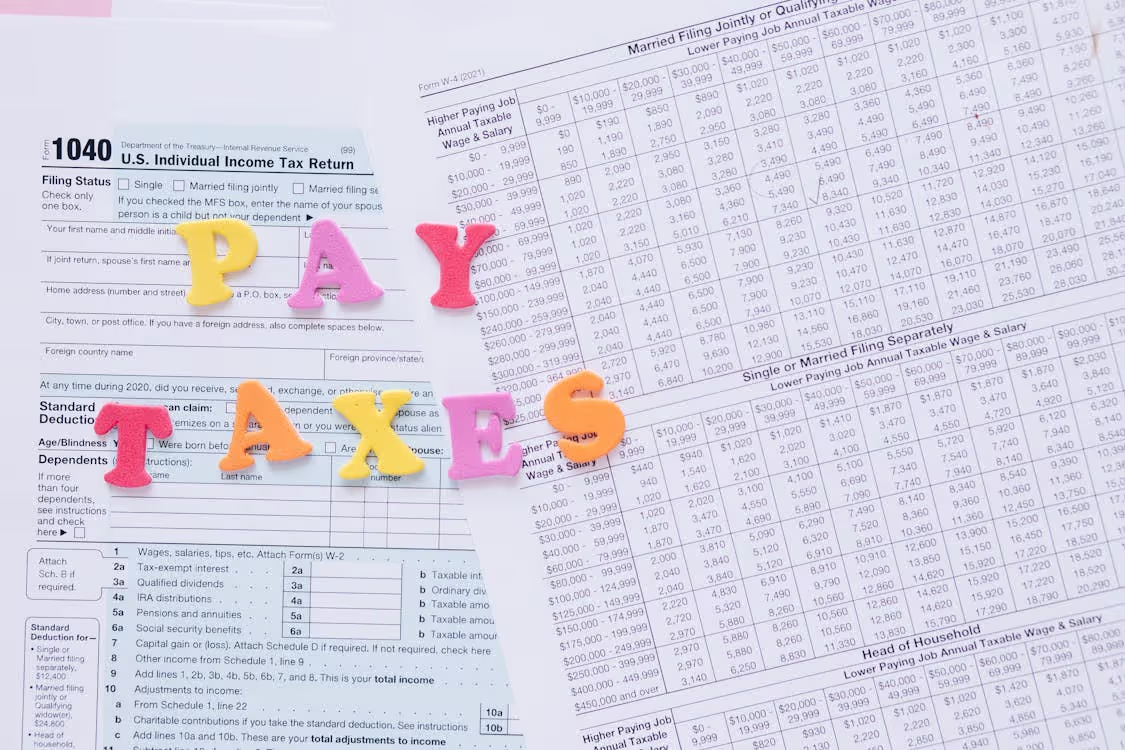
This guide covers how rental and management income is taxed in Arizona: what the state takes, what the IRS takes, who has to withhold on an out-of-state owner, and when each return is due. Every figure is tied to the statute, agency rule, or published guidance that sets it, so you can confirm a rate before acting on it.
State Income Tax On Rental And Management Income
Arizona levies a single flat individual income tax rate on Arizona taxable income, which flows from federal adjusted gross income. Rental income reported on federal Schedule E therefore carries into the Arizona return. A 2025 bill that would have cut the rate to 2.47 percent for tax year 2026 was not enacted, so the 2.5 percent flat rate remains the published rate. Arizona standard deduction amounts are adjusted annually.
- Arizona applies a flat 2.5 percent individual income tax rate to all income levels and filing statuses, and the older Optional Tax Table and X and Y Tax Table are obsolete. (ADOR Individual Income Tax Highlights, 2025 Highlights)
- The 2025 Arizona standard deduction amounts are $15,750 single or married filing separately, $31,500 married filing jointly, and $23,625 head of household. (ADOR Individual Income Tax Highlights)
- H.B. 2918 of the 2025 session would have cut the individual, estate and trust, and Arizona small business income tax rates from 2.5 percent to 2.47 percent for taxable years beginning January 1, 2026, and the state TPT rate from 5 percent to 4.93 percent. It did not become law, so property managers should not quote a 2.47 percent rate. (H.B. 2918, 57th Legislature, 1st Regular Session, Provisions 1 and 2)
- A 2025 individual income tax return for a calendar year filer is due April 15, 2026, and October 15, 2026 under a valid extension. (ADOR Individual Income Tax Highlights)
Withholding And Employer Taxes
A property management company with Arizona employees registers for withholding through the Joint Tax Application, which also starts unemployment insurance registration with the Department of Economic Security. Arizona withholding is elected by the employee as a percentage of gross taxable wages on Form A-4, with a statutory default if the employee does not file one. Deposit frequency is driven by the employer's rolling four quarter average withholding.
- All new employees subject to Arizona withholding must complete Form A-4 within five days of employment. If they do not, the employer must withhold at 2.0 percent until the employee elects a different rate. (ADOR Withholding Tax guidance, Arizona Form A-4)
- Registration is made on Arizona Form JT-1 through AZTaxes.gov, which also begins registration for unemployment compensation insurance with the Arizona Department of Economic Security. The withholding ID number with ADOR is the company's EIN. (ADOR Employer Withholding Filing Obligations)
- Deposit schedule depends on the previous four quarter Arizona withholding average: annually if under $200, quarterly if over $200 and up to $1,500, and monthly, semi-weekly or next business day if over $1,500 (matching the federal deposit timing). (Withholding Tax Procedure (WTP) 16-1)
- Employers must pay by electronic funds transfer if they owe $500 or more for any taxable year beginning after December 31, 2020. Failure to pay by EFT when required carries a penalty of 5 percent of the payment not made by EFT. (A.R.S. §§ 42-1125(O), 42-1129)
- For the 2022 tax year and beyond, all W-2s must be submitted electronically. (ADOR Employer Withholding Filing Obligations)
- ADOR follows the IRS determination of whether a worker is an employee or an independent contractor, per Arizona Withholding Tax Ruling WTR 16-4. (Arizona Withholding Tax Ruling (WTR) 16-4)
Federal Obligations
Federal reporting is where the biggest 2026 change lands for Arizona property managers. The long standing $600 information return threshold rose to $2,000 for payments in tax years beginning after 2025, and the electronic filing threshold is 10 or more information returns in the aggregate. A property manager who collects rent for an owner is the party that must issue the 1099-MISC to that owner.
- For tax years beginning after 2025, the minimum threshold for reporting certain payments on information returns and for backup withholding increased to $2,000, and may be adjusted for inflation beginning in calendar year 2027. (Instructions for Forms 1099-MISC and 1099-NEC, What's New)
- Form 1099-NEC is filed for each person paid at least $2,000 for services performed by someone who is not an employee. Form 1099-MISC box 1 reports rents of $2,000 or more. (Instructions for Forms 1099-MISC and 1099-NEC, boxes 1 and 1a)
- A payer does not report real estate rent paid to a real estate agent or property manager, but the real estate agent or property manager must use Form 1099-MISC to report the rent paid over to the property owner. (Instructions for Forms 1099-MISC and 1099-NEC, Box 1 Rents; Regulations section 1.6041-3(d))
- The electronic filing threshold is 10 or more information returns, calculated by aggregating all information returns, effective for returns required to be filed on or after January 1, 2024. (Instructions for Forms 1099-MISC and 1099-NEC, E-filing returns)
- Gross proceeds paid to an attorney of $600 or more are still reportable in box 10 of Form 1099-MISC, so the $600 figure has not disappeared everywhere. (Instructions for Forms 1099-MISC and 1099-NEC, Box 10)
Filing Deadlines
TPT returns are keyed to the 20th of the month after the reporting period, with later cutoffs for paper and electronic submission. Filing frequency is monthly, quarterly, seasonal or annual depending on the taxpayer. A zero dollar return is still required for a period with no activity, which is a common trap for seasonal short-term rental licenses.
- For July 2026 activity, the monthly TPT return deadline is August 20, paper returns must be received by ADOR by August 28, and electronic returns and payments must be submitted in AZTaxes before 11:59 p.m. on August 31. (A.R.S. § 42-5014)
- Quarterly TPT returns follow the same 20th of the month pattern, for example the deadline for the quarter ending June 2026 was July 20, 2026. (A.R.S. § 42-5014)
- Even if there were no sales or no tax due for a filing period, a $0 TPT return must still be filed. (ADOR Due Dates and Short-Term Lodging guidance)
- Individual income tax returns for calendar year 2025 were due April 15, 2026, with an extended due date of October 15, 2026. (ADOR Individual Income Tax Highlights)
- The Business Property Statement is due on or before April 1 with the county assessor. (A.R.S. § 42-15053(A))
Recent Changes Worth Tracking
- Laws 2023, Chapter 204 (S.B. 1131) prohibits, beginning January 1, 2025, a city, town or other taxing jurisdiction from levying a tax or fee on the business of residential rentals. (Laws 2023, Chapter 204, Provision 1)
- The same act required landlords to cease charging tenants the amount of the repealed residential rental TPT by January 1, 2025, placed the burden of proof on the landlord in any civil challenge, and repeals that rent reduction requirement on January 1, 2027. (Laws 2023, Chapter 204, Provisions 2 through 4)
- TPT licenses that carried only residential rental (business code 045) were automatically cancelled by ADOR with an effective date of December 31, 2024, and no action is needed by the owner to cancel. (ADOR Residential Rental Guidelines, What Should I Do)
- The class one commercial assessment ratio moves from 16 percent for 2025 to 15.5 percent for 2026 and 15 percent for 2027 and after, so any commercial assessment figure quoted in older content needs re-checking each year. (A.R.S. § 42-15001(15) through (17))
- H.B. 2918 of 2025, which would have reduced the individual income tax rate to 2.47 percent and the state TPT rate to 4.93 percent for 2026, was not enacted. (H.B. 2918, 57th Legislature, 1st Regular Session)
- Cities continue to change transient lodging rates. For example Tucson created a 10 percent rate for transient short-term rentals effective March 1, 2026, so short-term rental operators must track city rate and code updates. (ADOR Rate and Code Updates)
Tax is one half of Arizona compliance. See our guide to Arizona property management laws and regulations for licensing, trust account, and disclosure rules.
This page is one half of the picture. See our guide to the Arizona taxes a management company pays directly for the rest.
Keeping This Straight
Tax rates and thresholds move more often than most operators expect, and the figures circulating in older articles go stale quickly. Check any rate against its citation before you quote it to an owner, and re-check them at the start of each tax year.
This guide is a starting point for professional managers, not tax or legal advice. For a specific filing, work with a CPA familiar with Arizona rental property, and confirm current figures with the Arizona Department of Revenue or the IRS.
Sources
Every fact above is drawn from one of the official sources below.
- ADOR Individual Income Tax Highlights, 2025 Highlights, Arizona Department of Revenue, Individual Income Tax Highlights
- H.B. 2918, 57th Legislature, 1st Regular Session, Provisions 1 and 2, Arizona State Senate, H.B. 2918 Fact Sheet
- ADOR Withholding Tax guidance, Arizona Form A-4, Arizona Department of Revenue, Withholding Tax
- ADOR Employer Withholding Filing Obligations, Arizona Department of Revenue, Employer Withholding Filing Obligations
- Instructions for Forms 1099-MISC and 1099-NEC, What's New, Internal Revenue Service, Instructions for Forms 1099-MISC and 1099-NEC
- A.R.S. § 42-5014, Arizona Department of Revenue, Transaction Privilege Tax Due Dates
- A.R.S. § 42-15053(A), Arizona Department of Revenue, Property Tax FAQs
- Laws 2023, Chapter 204, Provision 1, Arizona State Senate, S.B. 1131 Fact Sheet as passed House
- ADOR Residential Rental Guidelines, What Should I Do, Arizona Department of Revenue, Residential Rental Guidelines
- A.R.S. § 42-15001(15) through (17), Arizona State Legislature, Arizona Revised Statutes § 42-15001
- ADOR Rate and Code Updates, Arizona Department of Revenue, Rate and Code Updates
Frequently asked questions
Arizona levies a single flat individual income tax rate on Arizona taxable income, which flows from federal adjusted gross income. Rental income reported on federal Schedule E therefore carries into the Arizona return. A 2025 bill that would have cut the rate to 2.47 percent for tax year 2026 was not enacted, so the 2.5 percent flat rate remains the published rate. Arizona standard deduction amounts are adjusted annually.
A property management company with Arizona employees registers for withholding through the Joint Tax Application, which also starts unemployment insurance registration with the Department of Economic Security. Arizona withholding is elected by the employee as a percentage of gross taxable wages on Form A-4, with a statutory default if the employee does not file one. Deposit frequency is driven by the employer's rolling four quarter average withholding.
Federal reporting is where the biggest 2026 change lands for Arizona property managers. The long standing $600 information return threshold rose to $2,000 for payments in tax years beginning after 2025, and the electronic filing threshold is 10 or more information returns in the aggregate. A property manager who collects rent for an owner is the party that must issue the 1099-MISC to that owner.
Services Tailored for the best Property Managers.
Whether it's rental property management, bookkeeping support, trust compliance, bank reconciliations, or emergencies - we're here to help.

Financial & Books Cleanup
Get your books and financials cleaned up to be 100% audit proof.

Trust Bookkeeping
We keep your trust books clean, tidy, and up to date.

Corporate Bookkeeping
Don't worry, we also keep your corporate books clean as well!

And so much more...
We provide a large array of services to help power the best PMs out there.