

Eviction Process In Pennsylvania
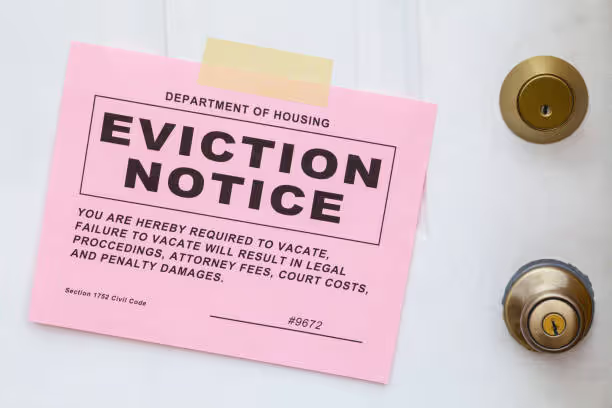
Evicting a tenant in Pennsylvania means following Landlord/Tenant Complaint (action for possession) in Magisterial District Court (Municipal Court in Philadelphia) exactly, start to finish. Skipping a step, whether it's the notice period, how the tenant is served, or the lockout procedure, can restart the clock or expose a management company to liability. This guide walks through each step with the statute or court rule behind it.
Everything below is sourced to Pennsylvania's own statutes and court self-help pages. Specific deadlines and dollar figures do change, so confirm the current text before you rely on a date in a live case.
Overview Of The Eviction Process
Pennsylvania's summary eviction proceeding is a Landlord/Tenant Complaint for possession, heard by a magisterial district judge (or Philadelphia Municipal Court), governed by the Landlord and Tenant Act of 1951.
- Pennsylvania evictions for recovery of possession are governed by the Landlord and Tenant Act of 1951, and are filed as a Landlord/Tenant Complaint before a magisterial district judge. (68 P.S. §§ 250.101-250.602)
- Landlord/Tenant complaint forms for use before a magisterial district judge are available through the Unified Judicial System of Pennsylvania's public forms page. (68 P.S. § 250.502)
Lawful Grounds For Eviction
Grounds include nonpayment of rent, lease expiration or breach of lease terms, and drug-related criminal activity on the premises, each carrying a different notice period.
- A landlord may seek possession where the tenant has failed to pay rent reserved and due, requiring a notice to quit before filing. (68 P.S. § 250.501)
- A landlord may seek possession upon the end of a lease term or upon breach of the lease or rental agreement's conditions, requiring a notice to quit before filing. (68 P.S. § 250.501)
- Where a tenant's continued occupancy poses a substantial risk of harm to others because of drug-related criminal activity on the leased premises, only ten days' notice is required regardless of the lease term. (68 P.S. § 250.501)
Notice Requirements
Notice periods under the notice to quit are 10 days for nonpayment of rent, 15 days for lease violations or expiration when the lease term is one year or less, and 30 days when the lease term exceeds one year.
- For failure to pay rent reserved and due, the notice to quit must specify that the tenant is to remove within ten days from the date of service. (68 P.S. § 250.501)
- For lease expiration or breach where the lease term is one year or less, the notice to quit must specify that the tenant is to remove within fifteen days from the date of service. (68 P.S. § 250.501)
- For lease expiration or breach where the lease term exceeds one year, the notice to quit must specify that the tenant is to remove within thirty days from the date of service. (68 P.S. § 250.501)
- The notice to quit may be served by personal delivery, by leaving it at the principal building on the premises, or by conspicuous posting on the leased premises. (68 P.S. § 250.501(f))
Filing The Case
Once the notice period expires and the tenant has not vacated, the landlord files a Landlord/Tenant Complaint with the magisterial district court covering the property's location.
- If the tenant has not moved within the time stated in the notice to quit, the landlord may file a Landlord/Tenant Complaint with the magisterial district court to seek repossession. (68 P.S. § 250.502)
Serving The Tenant
Upon filing, the magisterial district judge issues a summons directed to a constable, sheriff, or writ server, which may be served personally, by mail, or by posting on the premises, with personal service attempted with due diligence.
- Upon filing of the complaint, the magisterial district judge issues a summons directed to a constable, sheriff, or writ server, commanding that officer to summon the tenant to appear and answer the complaint on a date not less than seven nor more than ten days from the date of the summons. (68 P.S. § 250.502)
- The summons may be served personally on the tenant, by mail, or by posting it conspicuously on the leased premises, and posting is required in all cases to give notice to an occupant of the property. (246 Pa. Code Rule 506)
The Tenant's Response
The tenant must appear before the magisterial district judge on the summons date to contest the complaint; there is no separate written-answer deadline before that appearance.
- The summons requires the tenant to appear before the magisterial district judge to answer the landlord/tenant complaint on a date set not less than seven nor more than ten days from the date of the summons. (68 P.S. § 250.502)
Hearing And Judgment
The initial hearing before the magisterial district judge is set seven to ten days after the summons issues, and a judgment for possession awards the property to the landlord along with any proven rent and damages.
- The hearing is scheduled not less than seven nor more than ten days from the date of the summons. (68 P.S. § 250.502)
- If the landlord proves the case, the judgment for possession awards delivery of the property to the landlord and may include damages for wrongful detention and unpaid rent. (68 P.S. §§ 250.502-250.503)
The Writ And Lockout
After a ten-day wait following judgment, the landlord obtains an Order for Possession (writ of possession), which the constable or sheriff serves within 48 hours and then executes on the eleventh day following service; only the constable or sheriff may carry out the removal.
- The landlord must wait ten days after a judgment for possession before requesting the Order for Possession (writ of possession) from the magisterial district judge. (68 P.S. § 250.503)
- The writ of possession must be served on the tenant within 48 hours of issuance and is executed on the eleventh day following that service. (68 P.S. § 250.503)
- In nonpayment cases, before the writ is executed the tenant may supersede it and render it of no effect by paying the writ server the rent actually in arrears plus costs. (68 P.S. § 250.503)
- Only a constable or sheriff's deputy may execute the order for possession and physically remove a tenant; a landlord may not do so. (68 P.S. § 250.503)
Prohibited Practices
Pennsylvania's Landlord and Tenant Act establishes the magisterial district court process as the exclusive means of regaining possession; self-help removal, utility shutoffs, and lockouts outside that process are unlawful, and tenants have utility-shutoff protections under separate state acts.
- The Landlord and Tenant Act of 1951 requires a landlord to obtain possession through the notice-to-quit and magisterial district court complaint process; it does not authorize a landlord to retake possession by self-help. (68 P.S. §§ 250.501-250.503)
- Under the Utility Service Tenants Rights Act, a landlord generally may not have a utility discontinue service to a tenant's home; if the landlord requests discontinuance, the utility must give the tenant the right to keep the service on. (68 P.S. § 399.1 et seq. (Utility Service Tenants Rights Act))
Eviction is the last step in a relationship that's already gone wrong. See our guide to Pennsylvania property management laws and regulations for the licensing, disclosure, and trust-account rules that apply before it gets to this point.
Doing It By The Book
Self-help evictions, changing locks, removing doors, shutting off utilities, are illegal in every state and expose a management company to real liability regardless of how clear the nonpayment is. The court process exists because it's the only lawful way to remove a tenant, and skipping a step (a defective notice, bad service) is the single most common reason a case gets dismissed and restarted from day one.
This guide is a starting point for professional managers, not legal advice. For a specific case, a contested filing, or anything unusual, work with a Pennsylvania attorney, and confirm the current text of any rule cited above with Magisterial District Court (Municipal Court in Philadelphia) or the Pennsylvania legislature.
Sources
Every fact above is drawn from one of the official sources below.
- 68 P.S. §§ 250.101-250.602, Pennsylvania General Assembly, Landlord and Tenant Act of 1951
- 68 P.S. § 250.502, Unified Judicial System of Pennsylvania
- 68 P.S. § 250.501, Pennsylvania General Assembly, Landlord and Tenant Act of 1951
- 246 Pa. Code Rule 506, Pennsylvania Code, Rules of Civil Procedure for Magisterial District Judge Courts
- 68 P.S. § 399.1 et seq. (Utility Service Tenants Rights Act), Pennsylvania Office of Attorney General, Consumer Guide to Tenant and Landlord Rights
Frequently asked questions
Pennsylvania's summary eviction proceeding is a Landlord/Tenant Complaint for possession, heard by a magisterial district judge (or Philadelphia Municipal Court), governed by the Landlord and Tenant Act of 1951.
Notice periods under the notice to quit are 10 days for nonpayment of rent, 15 days for lease violations or expiration when the lease term is one year or less, and 30 days when the lease term exceeds one year.
Pennsylvania's Landlord and Tenant Act establishes the magisterial district court process as the exclusive means of regaining possession; self-help removal, utility shutoffs, and lockouts outside that process are unlawful, and tenants have utility-shutoff protections under separate state acts.
Managing rentals through an eviction?
An eviction lands on your books as well as your docket: the security deposit disposition, prorated or written-off rent, and the owner statement it all flows into. If you would rather have the accounting side handled while you handle the property, see how we keep trust accounts clean through move-outs, or find your state in our eviction process guides.