

Eviction Process In North Dakota
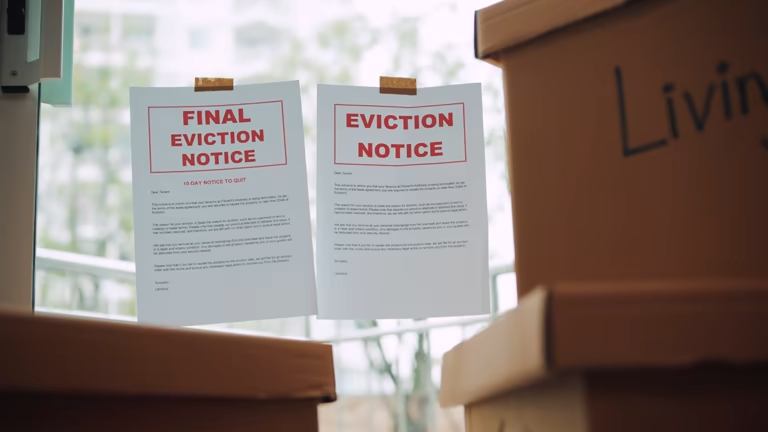
Evicting a tenant in North Dakota means following Eviction action in District Court exactly, start to finish. Skipping a step, whether it's the notice period, how the tenant is served, or the lockout procedure, can restart the clock or expose a management company to liability. This guide walks through each step with the statute or court rule behind it.
Everything below is sourced to North Dakota's own statutes and court self-help pages. Specific deadlines and dollar figures do change, so confirm the current text before you rely on a date in a live case.
Overview Of The Eviction Process
North Dakota's summary residential removal proceeding is called an eviction action. It is a civil action filed in state District Court, and a tenant cannot be removed without a district court order.
- Eviction is an accelerated civil legal action decided in North Dakota state district court to determine the right to possess the property; a tenant cannot be evicted without a district court order. (N.D.C.C. ch. 47-32)
- North Dakota's eviction procedure is codified at North Dakota Century Code Title 47, Chapter 47-32 (Eviction), which covers when eviction is maintainable, notice of intention to evict, and related provisions. (N.D.C.C. ch. 47-32)
- Only a lawyer licensed to practice in North Dakota can represent a legal entity (such as an LLC or corporation) in an eviction action. (N.D.C.C. ch. 47-32 (self-help guidance))
Lawful Grounds For Eviction
Eviction is maintainable for forcible or fraudulent entry and detention, for peaceable entry followed by forcible ouster, and for a lessee holding over after lease termination or failing to pay rent within three days of it being due.
- An eviction action is maintainable where a party, by force, intimidation, fraud, or stealth, enters upon and detains the prior actual possession of real property of another. (N.D.C.C. § 47-32-01)
- Eviction is maintainable where a party, after peaceably entering upon real property, turns out the party in possession by force, threats, or menacing conduct. (N.D.C.C. § 47-32-01)
- Eviction is maintainable where a lessee holds over after termination of the lease or expiration of the lessee's term. (N.D.C.C. § 47-32-01)
- Eviction is maintainable where a lessee fails to pay rent for three days after the rent is due. (N.D.C.C. § 47-32-01)
Notice Requirements
For holdover and nonpayment grounds, three days' written notice of intention to evict is required before an eviction action may be started.
- In cases arising under the holdover and nonpayment subsections of section 47-32-01, three days' written notice of intention to evict must be given to the lessee, subtenant, or party in possession before proceedings can be instituted. (N.D.C.C. § 47-32-02)
- The notice of intention to evict may be served and returned in the same manner as a summons; if the party cannot be found, the sheriff or a process server may serve it by posting the notice conspicuously on the premises. (N.D.C.C. § 47-32-02)
- The North Dakota Court System's Legal Self Help Center publishes a 3-Day Notice of Intention to Evict template, but clarifies that this is not itself an eviction order and that eviction still requires a district court order. (N.D.C.C. § 47-32-02 (self-help form))
Filing The Case
Eviction actions are filed in North Dakota District Court. The Legal Self Help Center publishes non-mandatory instructions and templates, since courts are not required to accept self-help forms.
- Eviction actions are commenced in North Dakota District Court once the required notice period has expired and the tenant has not vacated. (N.D.C.C. ch. 47-32)
- North Dakota Legal Self Help Center eviction forms, including the Eviction Summons, are not official court forms, and courts are not required to accept them; there is no guarantee that all judges and courts will accept forms available through the Center. (N.D.C.C. ch. 47-32 (self-help guidance))
Serving The Tenant
Service timing before the appearance date depends on whether personal service is made within the county or elsewhere.
- Service by delivery of a copy of the summons to the defendant in person within the county must be made at least three days before the time fixed for the defendant's appearance. (N.D.C.C. § 47-32-02)
- Service elsewhere, or personal service made in any other mode, must be made at least seven days before the time fixed for the defendant's appearance. (N.D.C.C. § 47-32-02)
The Tenant's Response
A written answer is optional and, if filed, is due shortly before the hearing.
- A written answer in a North Dakota eviction case is optional, and if filed, is due no later than 48 hours before the scheduled hearing. (N.D.C.C. ch. 47-32 (self-help guidance))
Hearing And Judgment
The hearing is generally scheduled within three to fifteen days after the summons is served, and judgment for the landlord can result in same-day possession unless hardship is claimed.
- After the notice period expires and the tenant has not left, the tenant receives a Summons and Complaint with a court hearing scheduled between three and fifteen days later. (N.D.C.C. ch. 47-32)
- If the judge rules for the landlord, eviction (surrender of possession) generally occurs the same day as judgment, unless the tenant claims hardship, which may extend the timeline up to five days. (N.D.C.C. ch. 47-32)
The Writ And Lockout
If the tenant does not move out after judgment, the court can issue a special execution directing the sheriff, and only the sheriff may physically remove the tenant.
- Only the sheriff or the sheriff's staff can carry out an eviction; the sheriff may remove a tenant only once a writ of special execution is issued and signed by the district court. (N.D.C.C. ch. 47-32 (self-help guidance))
Prohibited Practices
North Dakota prohibits self-help eviction: landlords cannot lock out a tenant, cut off utilities, or confiscate belongings without a court order, and forcible ejection carries treble damages.
- A landlord cannot lock a tenant out, cut off utilities, or confiscate belongings to remove a tenant without going through the court eviction process. (N.D.C.C. ch. 47-32)
- For forcibly ejecting or excluding a person from possession of real property, the measure of damages is three times the sum that would compensate for the detriment caused by the act. (N.D.C.C. § 32-03-29)
Recent Changes Worth Tracking
- Effective 2025 (Senate Bill 2238, 69th Legislative Assembly): North Dakota added a record-sealing provision to its eviction chapter allowing sealing of eviction records for nonpayment of rent or property damage, and immediate sealing for tenants evicted as a result of being a domestic violence victim in specified circumstances. (N.D.C.C. § 47-32-05)
Eviction is the last step in a relationship that's already gone wrong. See our guide to North Dakota property management laws and regulations for the licensing, disclosure, and trust-account rules that apply before it gets to this point.
Doing It By The Book
Self-help evictions, changing locks, removing doors, shutting off utilities, are illegal in every state and expose a management company to real liability regardless of how clear the nonpayment is. The court process exists because it's the only lawful way to remove a tenant, and skipping a step (a defective notice, bad service) is the single most common reason a case gets dismissed and restarted from day one.
This guide is a starting point for professional managers, not legal advice. For a specific case, a contested filing, or anything unusual, work with a North Dakota attorney, and confirm the current text of any rule cited above with District Court or the North Dakota legislature.
Sources
Every fact above is drawn from one of the official sources below.
- N.D.C.C. ch. 47-32, North Dakota Court System, Legal Self-Help Center
- N.D.C.C. ch. 47-32, North Dakota Legislative Branch, North Dakota Century Code
- N.D.C.C. § 47-32-02 (self-help form), North Dakota Court System, Legal Self-Help Center
- N.D.C.C. ch. 47-32 (self-help guidance), North Dakota Court System, Legal Self-Help Center
- N.D.C.C. ch. 47-32 (self-help guidance), North Dakota Court System, Legal Self-Help Center, Eviction for Tenants Informational Guide
- N.D.C.C. ch. 47-32, North Dakota Attorney General, Tenant Rights
- N.D.C.C. § 32-03-29, North Dakota Century Code, North Dakota Legislative Branch
Frequently asked questions
North Dakota's summary residential removal proceeding is called an eviction action. It is a civil action filed in state District Court, and a tenant cannot be removed without a district court order.
For holdover and nonpayment grounds, three days' written notice of intention to evict is required before an eviction action may be started.
North Dakota prohibits self-help eviction: landlords cannot lock out a tenant, cut off utilities, or confiscate belongings without a court order, and forcible ejection carries treble damages.
Managing rentals through an eviction?
An eviction lands on your books as well as your docket: the security deposit disposition, prorated or written-off rent, and the owner statement it all flows into. If you would rather have the accounting side handled while you handle the property, see how we keep trust accounts clean through move-outs, or find your state in our eviction process guides.