

Eviction Process In New York
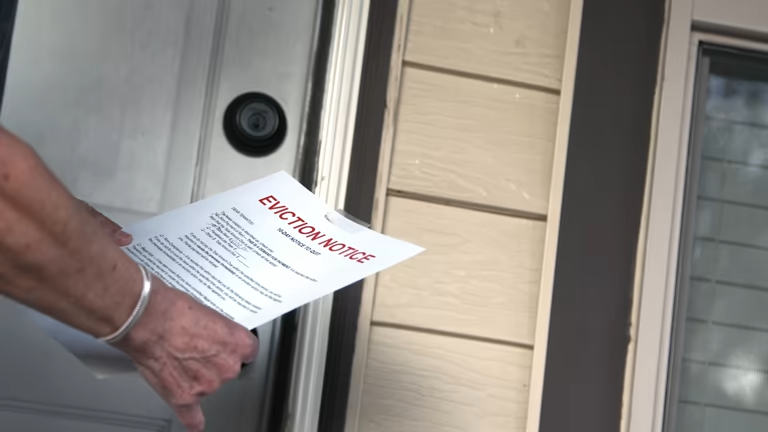
Evicting a tenant in New York means following Summary proceeding: nonpayment proceeding or holdover proceeding in Housing Court (Civil Court of the City of New York) in NYC; city, town, village, or district/county courts elsewhere in the state exactly, start to finish. Skipping a step, whether it's the notice period, how the tenant is served, or the lockout procedure, can restart the clock or expose a management company to liability. This guide walks through each step with the statute or court rule behind it.
Everything below is sourced to New York's own statutes and court self-help pages. Specific deadlines and dollar figures do change, so confirm the current text before you rely on a date in a live case.
Overview Of The Eviction Process
New York's eviction actions are RPAPL Article 7 summary proceedings, split into nonpayment proceedings (rent owed) and holdover proceedings (lease violation or unauthorized holding over). Statewide rules were substantially rewritten by the 2019 Housing Stability and Tenant Protection Act (HSTPA); New York City additionally has its own Good Cause Eviction Law, which is a distinct, NYC-specific overlay not shared by the rest of the state.
- A landlord may commence a summary non-payment proceeding to evict a tenant who fails to pay agreed rent when due, or a summary holdover proceeding where a tenant significantly violates a substantial lease obligation or stays beyond the lease term without permission. (RPAPL § 711)
- A tenant can be legally evicted only after the landlord brings a court proceeding and obtains a judgment of possession; only a sheriff, marshal, or constable may carry out a court-ordered warrant to evict. (RPAPL §§ 711, 749)
Lawful Grounds For Eviction
RPAPL 711 enumerates the grounds for a holdover or nonpayment special proceeding; New York City's Good Cause Eviction Law separately restricts non-renewal for many otherwise-unregulated units.
- A proceeding may be maintained where the tenant continues in possession of any part of the premises after expiration of the tenant's term, without the landlord's permission. (RPAPL § 711(1))
- A proceeding may be maintained where the tenant has defaulted in rent payment and a written demand for the rent has been made with at least 14 days' notice. (RPAPL § 711(2))
- A proceeding may be maintained where the premises are used or occupied for prostitution, an illegal trade, or other illegal business. (RPAPL § 711(5))
- New York City's Good Cause Eviction Law requires landlords of most non-regulated units in the city to show one of the law's enumerated grounds before evicting a tenant or refusing to renew a lease; other municipalities in the state may separately opt in to the law. (RPAPL § 741 (as amended); NYC application automatic)
Notice Requirements
HSTPA (2019) requires a 14-day written rent demand before a nonpayment proceeding and set tiered 30/60/90-day notices for ending certain periodic tenancies; a 3-day notice applies to tax/assessment defaults.
- Before a nonpayment proceeding, the landlord must make a written demand for the rent giving the tenant at least 14 days' notice; oral rent demands are not sufficient. (RPAPL § 711(2))
- A landlord of residential property must give 30, 60, or 90 days' notice of intention to terminate or not renew certain tenancies, with the period varying by length of occupancy or tenancy. (Real Property Law § 226-c)
- A proceeding for default in payment of taxes or assessments (60 days after they become due) requires at least 3 days' written notice. (RPAPL § 711(3))
Filing The Case
The landlord commences the proceeding by filing a Notice of Petition and Petition; a holdover petition must be served 10 to 17 days before its initial return date.
- A nonpayment case is started by filing court papers called a Notice of Petition and Petition once the 14-day rent demand period has expired without payment. (RPAPL § 731)
- A holdover notice of petition and petition must be served between 10 and 17 days before the initial return date in court. (RPAPL § 733(1))
Serving The Tenant
The notice of petition and petition may be served personally, on a suitable person at the premises, or by conspicuous-place service followed by mailing, with proof of service filed within 3 days.
- Service may be made by personally delivering the notice of petition and petition to the respondent, delivering to a person of suitable age and discretion at the property, or affixing a copy to a conspicuous part of the property if admittance cannot be obtained. (RPAPL § 735)
- Where substituted or conspicuous-place service is used, the server must also mail copies by both certified/registered and regular first-class mail within one day. (RPAPL § 735)
- Proof of service must be filed with the court within 3 days after service is made. (RPAPL § 735)
The Tenant's Response
Tenants may raise a payment defense (in nonpayment cases) up until the warrant is executed, and a statutory rebuttable presumption of retaliation.
- Until the tenant is evicted (i.e., the sheriff or marshal executes a warrant of eviction), a nonpayment case can be dismissed if the tenant pays all rent that is owed. (RPAPL § 731)
- In a nonpayment case, a tenant can only be evicted for not paying rent, not for other added fees such as late fees or legal fees. (RPAPL § 711(2))
- A presumption of unlawful retaliation arises if the landlord acts against the tenant (such as non-renewal or filing an eviction) within one year of the tenant's complaint; the burden then shifts to the landlord to prove a non-retaliatory motive. (Real Property Law § 223-b)
Hearing And Judgment
A judgment of possession may be paired with a money judgment for rent; courts may also grant tenants an extended stay of up to a year to relocate.
- A judgment of possession is required before a tenant may be legally evicted. (RPAPL § 749)
- If a tenant loses a housing case and is ordered evicted, the tenant may ask the court for up to one year to move if they show they cannot find a similar apartment in the same neighborhood. (RPAPL § 753)
The Writ And Lockout
The warrant of eviction is executed by a sheriff, marshal, or constable, who must give at least 14 days' written notice (increased from 72 hours by HSTPA) and coordinate for the safe removal of any companion animal.
- The officer to whom the warrant of eviction is directed must give at least 14 days' notice, in writing, to the persons to be evicted, and must execute the warrant on a business day between sunrise and sunset. (RPAPL § 749)
- The 14-day notice period replaced a prior 72-hour notice requirement, as amended by the Housing Stability and Tenant Protection Act of 2019. (RPAPL § 749, as amended by L. 2019, c. 36)
- Before executing the warrant, the officer must check for the presence of a companion animal and coordinate with the person or persons being evicted to provide for its safe and proper care; if the animal cannot be placed, the officer must coordinate with a humane society or animal control. (RPAPL § 749)
Prohibited Practices
RPAPL 768 criminalizes and imposes civil penalties for unlawful evictions, including force, lock changes, possession removal, essential-service shutoffs, and harassment; RPAPL 853 allows treble damages.
- Unlawful eviction includes using or threatening force, interrupting or discontinuing essential services (heat, water, or electricity), changing the lock on an entrance door without giving the occupant a key, removing an occupant's possessions, or repeated harassing conduct intended to prevent lawful occupancy. (RPAPL § 768)
- Committing or assisting in an unlawful eviction is a class A misdemeanor. (RPAPL § 768)
- Civil penalties for unlawful eviction range from $1,000 to $10,000 per violation, plus up to $100 per day (maximum six months) until the occupant is restored. (RPAPL § 768)
- A tenant evicted in a forcible or unlawful manner can recover treble (triple) damages in a legal action against the landlord. (RPAPL § 853)
Recent Changes Worth Tracking
- New York's Good Cause Eviction Law took effect statewide on April 20, 2024, automatically applying in New York City and available for other municipalities to adopt by local law; related notice and lease-disclosure requirements became effective August 18, 2024. (L. 2024, c. 56, Part HH (RPL Article 6-A; RPAPL § 741 amendment))
- Senate Bill S8612A, making technical clarifying changes to the Good Cause Eviction Law (rent-increase timelines, cooperative/condominium conversion requirements, and notice procedures), passed the Senate on June 2, 2026, but as of that update remained in Assembly Committee and had not yet been enacted into law. (2025 NY S8612A)
Eviction is the last step in a relationship that's already gone wrong. See our guide to New York property management laws and regulations for the licensing, disclosure, and trust-account rules that apply before it gets to this point.
Doing It By The Book
Self-help evictions, changing locks, removing doors, shutting off utilities, are illegal in every state and expose a management company to real liability regardless of how clear the nonpayment is. The court process exists because it's the only lawful way to remove a tenant, and skipping a step (a defective notice, bad service) is the single most common reason a case gets dismissed and restarted from day one.
This guide is a starting point for professional managers, not legal advice. For a specific case, a contested filing, or anything unusual, work with a New York attorney, and confirm the current text of any rule cited above with Housing Court (Civil Court of the City of New York) in NYC; city, town, village, or district/county courts elsewhere in the state or the New York legislature.
Sources
Every fact above is drawn from one of the official sources below.
- RPAPL § 711, New York Attorney General, Residential Tenants' Rights Guide
- RPAPL § 711(1), New York State Senate, Open Legislation, RPAPL § 711
- RPAPL § 741 (as amended); NYC application automatic, NYC Department of Housing Preservation and Development, Good Cause Eviction
- Real Property Law § 226-c, New York State Senate, Open Legislation, RPL § 226-c
- RPAPL § 731, New York Courts, Starting a Nonpayment Case Inside NYC
- RPAPL § 733(1), New York State Senate, Open Legislation, RPAPL § 733
- RPAPL § 735, New York State Senate, Open Legislation, RPAPL § 735
- RPAPL § 749, New York State Senate, Open Legislation, RPAPL § 749
- RPAPL § 768, New York Attorney General, Unlawful evictions (RPAPL section 768)
- 2025 NY S8612A, New York State Senate, Open Legislation, Bill S8612A
Frequently asked questions
New York's eviction actions are RPAPL Article 7 summary proceedings, split into nonpayment proceedings (rent owed) and holdover proceedings (lease violation or unauthorized holding over). Statewide rules were substantially rewritten by the 2019 Housing Stability and Tenant Protection Act (HSTPA); New York City additionally has its own Good Cause Eviction Law, which is a distinct, NYC-specific overlay not shared by the rest of the state.
HSTPA (2019) requires a 14-day written rent demand before a nonpayment proceeding and set tiered 30/60/90-day notices for ending certain periodic tenancies; a 3-day notice applies to tax/assessment defaults.
RPAPL 768 criminalizes and imposes civil penalties for unlawful evictions, including force, lock changes, possession removal, essential-service shutoffs, and harassment; RPAPL 853 allows treble damages.
Managing rentals through an eviction?
An eviction lands on your books as well as your docket: the security deposit disposition, prorated or written-off rent, and the owner statement it all flows into. If you would rather have the accounting side handled while you handle the property, see how we keep trust accounts clean through move-outs, or find your state in our eviction process guides.