

Eviction Process In New Mexico
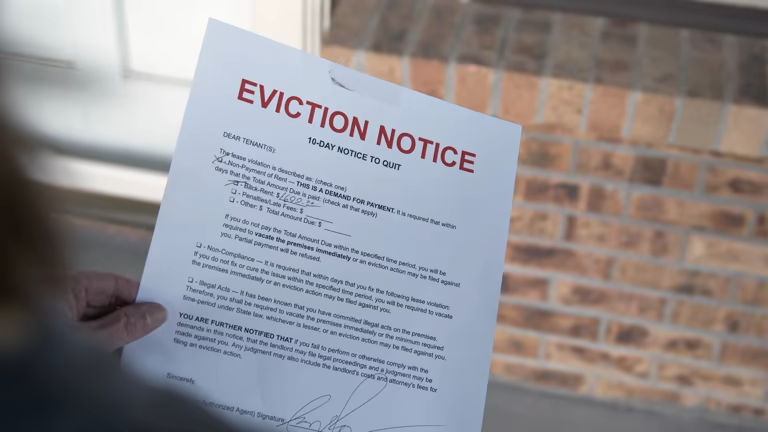
Evicting a tenant in New Mexico means following Petition by Owner for Restitution in Magistrate Court (or District Court) exactly, start to finish. Skipping a step, whether it's the notice period, how the tenant is served, or the lockout procedure, can restart the clock or expose a management company to liability. This guide walks through each step with the statute or court rule behind it.
Everything below is sourced to New Mexico's own statutes and court self-help pages. Specific deadlines and dollar figures do change, so confirm the current text before you rely on a date in a live case.
Overview Of The Eviction Process
New Mexico's eviction action is a Petition for Restitution filed under the Uniform Owner-Resident Relations Act, generally heard in Magistrate Court (or District Court in Santa Fe/Bernalillo areas and larger claims).
- New Mexico eviction procedure is governed by the Uniform Owner-Resident Relations Act, NMSA 1978, Sections 47-8-1 through 47-8-52. (NMSA 1978 §§ 47-8-1 to 47-8-52)
- A landlord must go to court and obtain a judgment before evicting a tenant; self-help eviction is not permitted. (NMSA 1978 § 47-8-36)
Lawful Grounds For Eviction
Grounds correspond to the three notice categories: nonpayment, lease violations curable within 7 days, and substantial/criminal violations, plus termination without cause on 30 days' notice for periodic tenancies.
- A tenant can be evicted for failing to pay rent, following a 3-day notice of nonpayment. (NMSA 1978 § 47-8-33)
- A tenant can be evicted for breaking lease rules/lease violations after a 7-day notice to cure. (NMSA 1978 § 47-8-33)
- A tenant can be evicted for committing a substantial violation, such as criminal activity or threatening the safety of others, following a 3-day notice of substantial violation. (NMSA 1978 § 47-8-33)
Notice Requirements
New Mexico uses four notice periods depending on the ground: 3-day nonpayment, 7-day lease-violation cure, 3-day substantial-violation, and 30-day no-cause/termination of a periodic tenancy.
- A 3-day notice of nonpayment of rent gives the tenant 3 days to pay overdue rent before the landlord may file suit. (NMSA 1978 § 47-8-33)
- A 7-day notice alerts the tenant of a lease violation and provides an opportunity to cure. (NMSA 1978 § 47-8-33)
- A 3-day notice of substantial violation applies to serious breaches such as criminal activity or safety threats. (NMSA 1978 § 47-8-33)
- A 30-day notice terminating a periodic (e.g., month-to-month) tenancy must be given at least 30 days before the tenant must move out. (NMSA 1978 § 47-8-37)
Filing The Case
The landlord files a Petition by Owner for Restitution with the clerk of the magistrate or district court, attaching the notices and lease.
- The landlord files a Petition by Owner for Restitution with the court clerk, including a completed signed petition, copies of all written notices, and a copy of the lease. (NMSA 1978 § 47-8-42)
- After filing, the court clerk prepares a Service Packet containing the hearing date, a copy of the petition, a blank Answer form, and a Summons. (NMSA 1978 § 47-8-42)
Serving The Tenant
The Service Packet must be delivered at least 7 days before the hearing by the sheriff, a private process server, or any non-party adult, using specified methods.
- The Service Packet must be delivered at least 7 days before the hearing by the county sheriff, a private process server, or any person 18 or older who is not a party to the case. (NMSA 1978 § 47-8-42)
- Valid service methods include direct delivery to the tenant, posting on the front door plus mailing a complete copy, or delivery to a household resident age 15 or older. (NMSA 1978 § 47-8-42)
- The server must complete a Return of Service on the Summons, which must be filed before the hearing or the case may be delayed. (NMSA 1978 § 47-8-42)
The Tenant's Response
The tenant may file an Answer, a Petition for Relief for lockout situations, or a counterclaim, but must also appear at the hearing.
- The tenant may file an Answer to the Petition for Restitution (form 4-907) by the hearing date or the deadline stated in the Summons, whichever is earlier. (NMSA 1978 § 47-8-42; NM Court Form 4-907)
- A tenant subjected to a lockout may file a Petition for Relief (form 4-906). (NM Court Form 4-906)
- Filing an Answer alone is not sufficient; the tenant must appear at the hearing to present evidence. (NMSA 1978 § 47-8-42)
Hearing And Judgment
The hearing occurs on the date set out in the Service Packet; judgment against the tenant results in forfeiture of the rental agreement and a writ of restitution.
- The hearing occurs on the date specified in the Service Packet delivered with the summons. (NMSA 1978 § 47-8-42)
- If judgment for restitution is rendered against the tenant, the court declares forfeiture of the rental agreement. (NMSA 1978 § 47-8-46)
The Writ And Lockout
The court issues a writ of restitution directing the sheriff to restore possession, generally 3 to 7 days after judgment for an owner, or within 24 hours for a resident's wrongful-lockout petition.
- On a petition for restitution filed by the owner, if judgment is for the owner, the court issues a writ of restitution directing the sheriff to restore possession on a specified date not less than 3 nor more than 7 days after entry of judgment. (NMSA 1978 § 47-8-46)
- On a petition for restitution filed by the resident (e.g., after an unlawful lockout), if judgment is for the resident, the writ of restitution directs the sheriff to restore possession within 24 hours after entry of judgment. (NMSA 1978 § 47-8-46)
Prohibited Practices
New Mexico bars owners from excluding, removing, or dispossessing a resident without a court order, including through lock changes or utility shutoffs.
- An owner, or anyone acting on the owner's behalf, may not knowingly exclude, remove, threaten, or attempt to remove or dispossess a resident from a dwelling unit without a court order, including by fraud, changing/adding/removing locks, or blocking entrances. (NMSA 1978 § 47-8-36(A))
- The statute also bars owners from removing utilities such as electricity, gas, hot or cold water, plumbing, heat, or telephone service as a means of forcing a resident out, though it does not require the owner to make utility payments on the resident's behalf. (NMSA 1978 § 47-8-36)
Eviction is the last step in a relationship that's already gone wrong. See our guide to New Mexico property management laws and regulations for the licensing, disclosure, and trust-account rules that apply before it gets to this point.
Doing It By The Book
Self-help evictions, changing locks, removing doors, shutting off utilities, are illegal in every state and expose a management company to real liability regardless of how clear the nonpayment is. The court process exists because it's the only lawful way to remove a tenant, and skipping a step (a defective notice, bad service) is the single most common reason a case gets dismissed and restarted from day one.
This guide is a starting point for professional managers, not legal advice. For a specific case, a contested filing, or anything unusual, work with a New Mexico attorney, and confirm the current text of any rule cited above with Magistrate Court (or District Court) or the New Mexico legislature.
Sources
Every fact above is drawn from one of the official sources below.
- NMSA 1978 §§ 47-8-1 to 47-8-52, New Mexico Courts, Landlord-Tenant Self-Representation page
- NMSA 1978 § 47-8-46, New Mexico Courts, official form 4-904 (citing NMSA 1978 §§ 47-8-42 and 47-8-46)
Frequently asked questions
New Mexico's eviction action is a Petition for Restitution filed under the Uniform Owner-Resident Relations Act, generally heard in Magistrate Court (or District Court in Santa Fe/Bernalillo areas and larger claims).
New Mexico uses four notice periods depending on the ground: 3-day nonpayment, 7-day lease-violation cure, 3-day substantial-violation, and 30-day no-cause/termination of a periodic tenancy.
New Mexico bars owners from excluding, removing, or dispossessing a resident without a court order, including through lock changes or utility shutoffs.
Managing rentals through an eviction?
An eviction lands on your books as well as your docket: the security deposit disposition, prorated or written-off rent, and the owner statement it all flows into. If you would rather have the accounting side handled while you handle the property, see how we keep trust accounts clean through move-outs, or find your state in our eviction process guides.