

Eviction Process In Minnesota
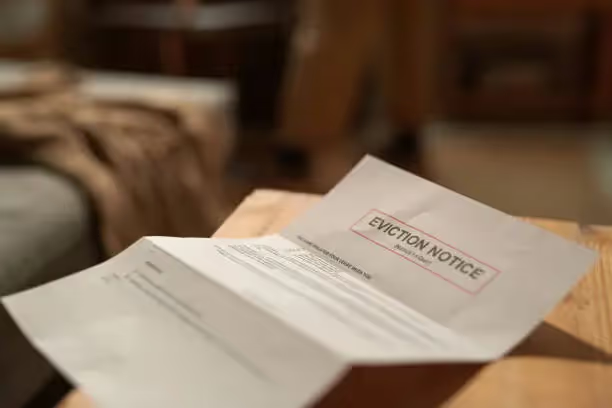
Evicting a tenant in Minnesota means following eviction action in District Court (Housing Court in some counties) exactly, start to finish. Skipping a step, whether it's the notice period, how the tenant is served, or the lockout procedure, can restart the clock or expose a management company to liability. This guide walks through each step with the statute or court rule behind it.
Everything below is sourced to Minnesota's own statutes and court self-help pages. Specific deadlines and dollar figures do change, so confirm the current text before you rely on a date in a live case.
Overview Of The Eviction Process
Minnesota's summary possession action is the "eviction action," governed by Minnesota Statutes chapter 504B and filed in district court, with specialized Housing Court divisions in some counties.
- Eviction actions in Minnesota are governed by Minnesota Statutes chapter 504B ("Landlord and Tenant"), including the eviction-action provisions. (Minn. Stat. ch. 504B)
- An eviction action is required to remove a tenant from rental property; self-help evictions such as changing locks or shutting off utilities are illegal. (Minn. Stat. ch. 504B)
Lawful Grounds For Eviction
Grounds include nonpayment of rent and end of a tenancy at will (effectively allowing no-cause termination with adequate notice); lease-violation grounds must be documented in the complaint.
- A landlord may bring an eviction action for nonpayment of rent, and such an action is treated as equivalent to a demand for the rent. (Minn. Stat. § 504B.291)
- A tenancy at will may be terminated by either landlord or tenant with written notice equal to the interval between rent payments, or three months, whichever is less. (Minn. Stat. § 504B.135)
- A complaint alleging breach of lease must specify the lease clause, the nature of the conduct, and the dates, and a nonpayment complaint must include an itemized accounting of amounts owed. (Minn. Stat. § 504B.321)
Notice Requirements
Before filing for nonpayment, the landlord must give written notice of the amount owed; termination of a tenancy at will requires notice tied to the rental interval.
- Before bringing an eviction action for nonpayment of rent or another unpaid financial obligation under the lease, a landlord must give written notice specifying the basis for the future action, including an itemized accounting of the total due. (Minn. Stat. § 504B.291)
- If the tenant does not correct the rent delinquency within 14 days of delivery/mailing of the notice (or a longer period required by local law) or vacate, the landlord may then bring the eviction action. (Minn. Stat. § 504B.291)
- Notice to terminate a tenancy at will must be at least as long as the interval between rent due dates, or three months, whichever is less. (Minn. Stat. § 504B.135)
Filing The Case
The complaint is filed in district court in the county where the property sits, must name the tenant and describe the factual basis, and the summons sets a hearing date 7-14 days out (5-7 days for expedited safety cases).
- The complaint must include the defendant's full name and date of birth (if known), a description of the premises, and the facts authorizing recovery of possession, with the lease and any required notice attached. (Minn. Stat. § 504B.321)
- In a standard eviction case the summons must set the hearing not less than 7 nor more than 14 days from the date of issuing the summons. (Minn. Stat. § 504B.321)
- In expedited cases based on safety or property damage, the hearing must be set not less than 5 nor more than 7 days out, with service required within 24 hours of issuance. (Minn. Stat. § 504B.321)
Serving The Tenant
Service timing is tied to the summons: standard cases require the hearing to be set 7-14 days after issuance, and courts advise service be completed at least 7 days before the hearing.
- Service of the eviction summons and complaint must be completed at least 7 days before the hearing. (Minn. Stat. ch. 504B)
- The summons must state the hearing date, time, and location, information about methods for participating in the court appearance, and notice of the right to legal assistance. (Minn. Stat. § 504B.321)
The Tenant's Response
A tenant may file a written Answer at the Housing Court counter before the hearing; a jury trial may be requested, subject to a jury fee.
- A tenant who prepares a written Answer to the eviction complaint files it, along with any filing fee, at the Housing Court counter. (Minn. Stat. ch. 504B)
- A party requesting a jury trial in an eviction case may be required to pay a jury fee. (Minn. Stat. ch. 504B)
Hearing And Judgment
The hearing date is fixed by the summons itself (7-14 days from issuance in standard cases, 5-7 days in expedited safety/damage cases).
- Standard eviction cases must be set for hearing not less than 7 nor more than 14 days after the summons is issued. (Minn. Stat. § 504B.321)
- Expedited cases involving safety or property damage must be set for hearing not less than 5 nor more than 7 days after the summons is issued. (Minn. Stat. § 504B.321)
The Writ And Lockout
After judgment, the court issues a writ of recovery of the premises and order to vacate, executed by a sheriff or licensed peace officer, with strict property-handling rules.
- A writ of recovery of premises and order to vacate is executed by a county officer or a licensed police officer/community crime prevention officer, who directs the occupant to relinquish possession and remove family and personal property within 24 hours. (Minn. Stat. § 504B.365)
- Before enforcement, the plaintiff must send notice of the scheduled enforcement date by first-class mail and make a good-faith effort to notify the defendant by telephone. (Minn. Stat. § 504B.365)
- If property is removed and stored off-premises, the plaintiff bears the removal/storage cost, holds a lien, and after 60 days of nonpayment may hold a public sale; if left on the premises, the plaintiff must inventory it and mail the inventory to the tenant's last known address. (Minn. Stat. § 504B.365)
Prohibited Practices
Self-help removal or exclusion of a tenant, including utility shutoffs or removing doors/locks, is unlawful and can be immediately reversed by court order.
- Unlawful exclusion or removal of a residential tenant, including termination of utilities or removal of doors, windows, or locks, is prohibited; if a petition shows the exclusion was unlawful, the court must immediately order the tenant restored to possession. (Minn. Stat. § 504B.375)
- A landlord may recover possession from an unlawfully-excluded tenant only through a proper eviction action or as otherwise provided by law, not through self-help. (Minn. Stat. § 504B.375)
Eviction is the last step in a relationship that's already gone wrong. See our guide to Minnesota property management laws and regulations for the licensing, disclosure, and trust-account rules that apply before it gets to this point.
Doing It By The Book
Self-help evictions, changing locks, removing doors, shutting off utilities, are illegal in every state and expose a management company to real liability regardless of how clear the nonpayment is. The court process exists because it's the only lawful way to remove a tenant, and skipping a step (a defective notice, bad service) is the single most common reason a case gets dismissed and restarted from day one.
This guide is a starting point for professional managers, not legal advice. For a specific case, a contested filing, or anything unusual, work with a Minnesota attorney, and confirm the current text of any rule cited above with District Court (Housing Court in some counties) or the Minnesota legislature.
Sources
Every fact above is drawn from one of the official sources below.
- Minn. Stat. ch. 504B, Minnesota Office of the Revisor of Statutes
- Minn. Stat. ch. 504B, Minnesota Judicial Branch
- Minn. Stat. § 504B.291, Minnesota Office of the Revisor of Statutes
- Minn. Stat. § 504B.135, Minnesota Office of the Revisor of Statutes
- Minn. Stat. § 504B.321, Minnesota Office of the Revisor of Statutes
- Minn. Stat. ch. 504B, Minnesota Judicial Branch, Hennepin County Housing Court
- Minn. Stat. § 504B.365, Minnesota Office of the Revisor of Statutes
- Minn. Stat. § 504B.375, Minnesota Office of the Revisor of Statutes
Frequently asked questions
Minnesota's summary possession action is the "eviction action," governed by Minnesota Statutes chapter 504B and filed in district court, with specialized Housing Court divisions in some counties.
Before filing for nonpayment, the landlord must give written notice of the amount owed; termination of a tenancy at will requires notice tied to the rental interval.
Self-help removal or exclusion of a tenant, including utility shutoffs or removing doors/locks, is unlawful and can be immediately reversed by court order.
Managing rentals through an eviction?
An eviction lands on your books as well as your docket: the security deposit disposition, prorated or written-off rent, and the owner statement it all flows into. If you would rather have the accounting side handled while you handle the property, see how we keep trust accounts clean through move-outs, or find your state in our eviction process guides.