

Eviction Process In Michigan
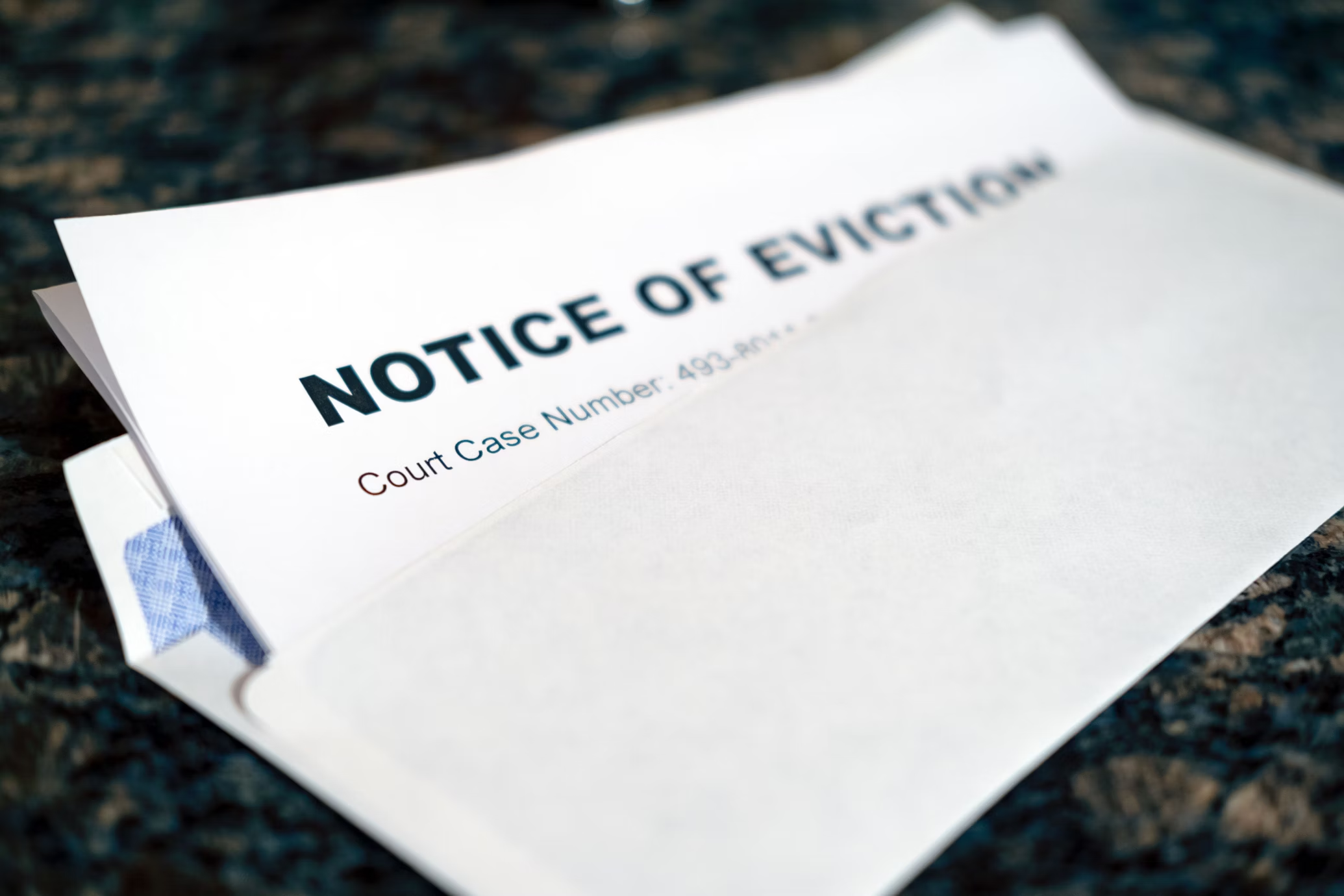
Evicting a tenant in Michigan means following summary proceedings to recover possession of premises in District Court exactly, start to finish. Skipping a step, whether it's the notice period, how the tenant is served, or the lockout procedure, can restart the clock or expose a management company to liability. This guide walks through each step with the statute or court rule behind it.
Everything below is sourced to Michigan's own statutes and court self-help pages. Specific deadlines and dollar figures do change, so confirm the current text before you rely on a date in a live case.
Overview Of The Eviction Process
Michigan's summary eviction action is called "summary proceedings," heard in the district court under the Summary Proceedings Act (MCL 600.5701 et seq., Chapter 57 of the Revised Judicature Act), with procedure also governed by MCR 4.201.
- Summary proceedings are governed by the Summary Proceedings Act, MCL 600.5701 et seq. (Chapter 57 of the Revised Judicature Act of 1961). (MCL 600.5701)
- District court case procedure for landlord-tenant summary proceedings is governed by Michigan Court Rule 4.201. (MCR 4.201)
- A judgment for possession under the summary proceedings chapter does not merge or bar a separate civil action for damages. (MCL 600.5750)
Lawful Grounds For Eviction
Grounds include nonpayment of rent, lease/health-hazard violations, drug activity, threats/injury, and holdover, each tied to a specific notice period under MCL 600.5714.
- A landlord may evict a tenant who holds over and continues in possession after failing or refusing to pay rent due, following a 7-day written demand for possession. (MCL 600.5714)
- A tenant who willfully or negligently causes a serious and continuing health hazard or extensive physical injury to the premises may be evicted after 7 days' notice, if discovered within 90 days of the proceeding. (MCL 600.5714)
- A tenant may be evicted after only 24 hours' notice where a police report alleges unlawful manufacture, delivery, or possession of a controlled substance on the premises. (MCL 600.5714)
- A tenant who caused or threatened physical injury to a person on the landlord's property, reported to police, may be evicted after 7 days' notice to quit. (MCL 600.5714)
Notice Requirements
Notice periods range from 24 hours (drug activity) to 7 days (nonpayment, damage/health hazard, threats), and the demand must be served by an approved method.
- For nonpayment, the tenant must be given a written demand for possession and has 7 days from service to pay back rent and late fees before a summary proceedings case may be filed. (MCL 600.5714)
- A demand for possession may be served by personal delivery to the tenant, personal delivery to a household member/employee on the premises, first-class mail, or electronic service if the tenant has consented in writing. (MCL 600.5718)
- If a demand is mailed, the date of service is the next regular mail-delivery day after mailing. (MCL 600.5718)
Filing The Case
The complaint is filed in district court on SCAO-approved forms specific to the ground alleged, with a matching summons form.
- Form DC 102a, "Complaint, Nonpayment of Rent," is used when a tenant has not paid rent or moved out after a demand for possession. (SCAO Form DC 102a)
- Form DC 102b, "Complaint, Damage/Health Hazard to Property," is used for damage/health-hazard grounds, and DC 102c, "Complaint to Recover Possession of Property," is used for termination of tenancy, expired lease, trespass, or forcible entry. (SCAO Forms DC 102b, DC 102c)
- Form DC 104, "Summons, Landlord-Tenant," is filed together with the complaint in district court. (SCAO Form DC 104)
Serving The Tenant
The demand for possession and the summons/complaint each have their own service rules, and the initial hearing must be scheduled within 10 days of service of the summons.
- A demand for possession may be served by personal delivery, delivery to a household member/employee, first-class mail, or consented electronic service. (MCL 600.5718)
- The district court must set the initial hearing within 10 days of service of the summary-proceedings summons on the tenant. (MCR 4.201(G))
The Tenant's Response
The defendant must appear and answer by the date on the summons, either in writing or orally at the hearing, and bears the burden of proving any defenses raised.
- The defendant must appear and answer the complaint by the date printed on the summons, or may instead appear at the hearing and orally answer each allegation on the record. (MCR 4.201(G)(1))
- A tenant has the burden of proving any defenses raised, whether as a counterclaim or an affirmative defense. (MCR 2.507(B)(2))
Hearing And Judgment
Trial follows shortly after the answer/appearance date, with limited adjournments, and the court enters findings supporting the judgment for possession.
- A summary proceeding must be heard within 7 days after the defendant's appearance or trial date and generally cannot be adjourned beyond that except by written stipulation or on the record. (MCL 600.5735(6))
- If trial is adjourned, it must generally be rescheduled at least 7 but not more than 14 days after the initial date, extendable up to 56 days for good cause. (MCR 4.201(K)(1))
- In a bench trial the court must find the facts specially, state its conclusions of law separately, and direct entry of the appropriate judgment. (MCR 2.517(A)(1))
The Writ And Lockout
The removal order is the "writ of restitution," generally issued no sooner than 10 days after judgment and executed by a court officer, bailiff, sheriff, or local law enforcement.
- A writ of restitution generally must not be issued until 10 days after entry of the judgment for possession, though immediate issuance is allowed in certain circumstances (e.g., housing-code certification failure, unlawful forcible entry). (MCL 600.5744)
- The writ is directed to a court officer or bailiff of the issuing court, the sheriff or deputy sheriff of the county, or a local law enforcement officer, who restores the plaintiff to full, peaceful possession. (MCL 600.5744)
- The officer executing the writ removes occupants and property, then leaves belongings in an area open to the public or the public right-of-way, or delivers them to the sheriff; the officer determines whether property was abandoned. (MCL 600.5744)
Prohibited Practices
Michigan's "anti-lockout law" bars landlords from forcibly or unlawfully ejecting tenants or interfering with a tenant's possessory interest, with statutory multiple damages.
- A person forcibly and unlawfully ejected, or afterward held out by force, may recover 3 times actual damages or $200, whichever is greater, plus recovery of possession. (MCL 600.2918)
- A tenant in possession whose possessory interest is unlawfully interfered with by the owner may recover actual damages or $200, whichever is greater, for each occurrence, and may recover possession if it was lost. (MCL 600.2918)
Eviction is the last step in a relationship that's already gone wrong. See our guide to Michigan property management laws and regulations for the licensing, disclosure, and trust-account rules that apply before it gets to this point.
Doing It By The Book
Self-help evictions, changing locks, removing doors, shutting off utilities, are illegal in every state and expose a management company to real liability regardless of how clear the nonpayment is. The court process exists because it's the only lawful way to remove a tenant, and skipping a step (a defective notice, bad service) is the single most common reason a case gets dismissed and restarted from day one.
This guide is a starting point for professional managers, not legal advice. For a specific case, a contested filing, or anything unusual, work with a Michigan attorney, and confirm the current text of any rule cited above with District Court or the Michigan legislature.
Sources
Every fact above is drawn from one of the official sources below.
- MCL 600.5701, Michigan Legislature
- MCR 4.201, Michigan Judicial Institute, Landlord-Tenant Benchbook (Michigan Courts)
- MCL 600.5714, Michigan Legislature
- MCL 600.5718, Michigan Legislature
- SCAO Form DC 102a, Michigan Courts (State Court Administrative Office)
- SCAO Forms DC 102b, DC 102c, Michigan Courts (State Court Administrative Office)
- SCAO Form DC 104, Michigan Courts (State Court Administrative Office)
- MCR 4.201(G), Michigan Judicial Institute, Landlord-Tenant Benchbook (Michigan Courts)
- MCR 2.507(B)(2), Michigan Judicial Institute, Landlord-Tenant Benchbook (Michigan Courts)
- MCL 600.5744, Michigan Legislature
- MCL 600.2918, Michigan Legislature
Frequently asked questions
Michigan's summary eviction action is called "summary proceedings," heard in the district court under the Summary Proceedings Act (MCL 600.5701 et seq., Chapter 57 of the Revised Judicature Act), with procedure also governed by MCR 4.201.
Notice periods range from 24 hours (drug activity) to 7 days (nonpayment, damage/health hazard, threats), and the demand must be served by an approved method.
Michigan's "anti-lockout law" bars landlords from forcibly or unlawfully ejecting tenants or interfering with a tenant's possessory interest, with statutory multiple damages.
Managing rentals through an eviction?
An eviction lands on your books as well as your docket: the security deposit disposition, prorated or written-off rent, and the owner statement it all flows into. If you would rather have the accounting side handled while you handle the property, see how we keep trust accounts clean through move-outs, or find your state in our eviction process guides.