

Eviction Process In Maryland
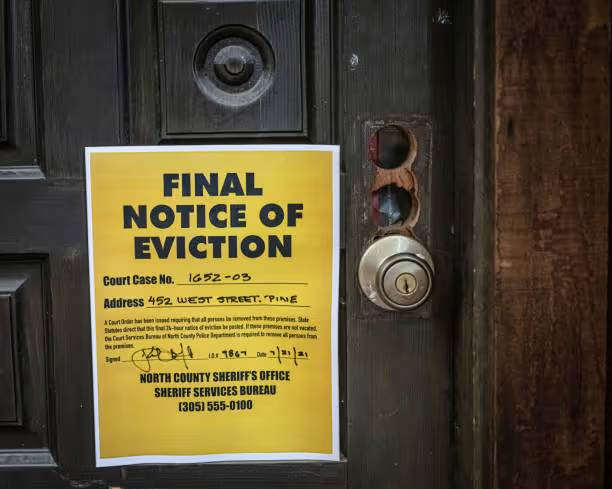
Evicting a tenant in Maryland means following summary ejectment (nonpayment of rent) and tenant holding over action (holdover/breach of lease) in District Court of Maryland exactly, start to finish. Skipping a step, whether it's the notice period, how the tenant is served, or the lockout procedure, can restart the clock or expose a management company to liability. This guide walks through each step with the statute or court rule behind it.
Everything below is sourced to Maryland's own statutes and court self-help pages. Specific deadlines and dollar figures do change, so confirm the current text before you rely on a date in a live case.
Overview Of The Eviction Process
Maryland residential eviction for nonpayment proceeds as a "summary ejectment" under Real Property Article section 8-401, while holdover and lease-breach cases proceed under section 8-402, both filed in the District Court of Maryland in the county where the property is located.
- A landlord may recover possession for nonpayment of rent through a summary ejectment complaint filed in the District Court of the county where the property is located. (Md. Code, Real Property section 8-401)
- A separate "tenant holding over" procedure under section 8-402 applies when a tenant unlawfully remains after the tenancy has ended or the lease has been breached. (Md. Code, Real Property section 8-402)
Lawful Grounds For Eviction
Nonpayment of rent and tenant holdover after lawful termination (including lease breach) are the two statutory tracks.
- Failure to pay rent when due is the ground for a summary ejectment action. (Md. Code, Real Property section 8-401)
- A tenant holding over after the tenancy's term ends, or after breach of a lease covenant, is a separate ground under the tenant-holding-over statute, allowing the landlord to recover both possession and damages for the holdover period. (Md. Code, Real Property section 8-402(a), (b))
Notice Requirements
Nonpayment cases now require a mandatory 10-day pre-filing cure notice; holdover notice periods scale with the tenancy type.
- Before filing a nonpayment case, the landlord must give the tenant a written notice, on a Maryland Judiciary-approved form, giving the tenant 10 days to cure the nonpayment; the notice may be delivered by first-class mail with a certificate of mailing, by affixing it to the door, or electronically if the tenant has elected that method. (Md. Code, Real Property section 8-401(c))
- Notice to terminate a holdover tenancy must be given in writing for periods scaled to the tenancy: 60 days for a month-to-month tenancy, 90 days for a year-to-year non-farm tenancy, 180 days for a farm tenancy, 7 days for a week-to-week tenancy with a written lease, and 21 days for a week-to-week tenancy without a written lease. (Md. Code, Real Property section 8-402(c))
- Outside Baltimore City, if the tenant gives the landlord at least 30 days' oral notice of intent to vacate, the landlord's written termination notice is not required. (Md. Code, Real Property section 8-402(c))
Filing The Case
The complaint is filed in the District Court and must include specific property, rent, and tenant details; a separate pre-filing notice form is now mandatory for nonpayment cases.
- The summary ejectment complaint must include a description of the property, the name of each tenant (including assignees or subtenants), the amount of rent and any late fees due and unpaid, and a request for repossession and judgment. (Md. Code, Real Property section 8-401(b))
- The Maryland Judiciary's official pre-filing notice form for nonpayment cases is a "Notice of Intent to File a Complaint for Summary Ejectment." (Maryland Judiciary form DC-CV-115)
Serving The Tenant
Service is by the constable or sheriff, via mail, personal service, or posting, though posting alone will not support a default money judgment.
- The court issues a summons to be served by a constable or sheriff by first-class mail, by personal service if requested, or by posting conspicuously on the property. (Md. Code, Real Property section 8-401(b))
- Affixing the summons to the property is conclusively presumed sufficient service to support a judgment for possession, but it is not sufficient, standing alone, to support a default judgment for the amount of rent due. (Md. Code, Real Property section 8-401(b))
The Tenant's Response
Trial is set quickly for nonpayment cases, and the tenant retains a redemption right up until actual execution.
- Trial in a nonpayment summary ejectment case is set for the fifth day after the complaint is filed. (Md. Code, Real Property section 8-401)
- A tenant may redeem the tenancy by paying all past-due rent plus court costs at any time before actual execution of the eviction order, unless the tenant has already had three possession judgments entered in the preceding 12 months. (Md. Code, Real Property section 8-401(h))
Hearing And Judgment
Judgment for possession triggers a strict deadline for the landlord to obtain a warrant of restitution or lose the judgment.
- The landlord must order the warrant of restitution within 60 days of judgment, or the possession judgment is stricken; if the warrant is ordered but not executed within 60 days, it expires and the judgment is likewise stricken. (Md. Code, Real Property section 8-401(f))
- Extreme weather (temperatures at or below 32 degrees Fahrenheit, or winter storm, hurricane, or heat warnings) triggers an automatic daily stay of execution for residential properties. (Md. Code, Real Property section 8-401(f))
The Writ And Lockout
A new statute (effective October 2025) requires a separate written notice before the warrant of restitution is executed, on top of the warrant itself.
- The warrant of restitution is executed by the sheriff or constable, who may remove the tenant's furniture, implements, tools, goods, effects, or other chattels from the premises. (Md. Code, Real Property section 8-401(f))
- The landlord must give the tenant a written "Notice to Tenant of Pending Eviction" at least 6 days before the scheduled repossession date (local jurisdictions may set 4 to 14 days), delivered by first-class mail with certificate of mailing, by dated-photograph posting on the front door, and electronically if contact information is available; the notice must state the case number, the tenant's name and address, the court order date, the scheduled eviction date, and any redemption amount, and warns of the loss of personal belongings. (Md. Code, Real Property section 8-407)
- If the sheriff doubts that proper pre-eviction notice was given, the sheriff must notify the District Court before executing the warrant; a court that finds a notice violation must vacate the warrant and may award the tenant actual damages, attorney's fees, injunctive relief, or other remedies. (Md. Code, Real Property section 8-407)
Prohibited Practices
Self-help eviction, including lockouts and utility shutoffs, is banned; lawful possession can only come through a warrant of restitution or genuine abandonment/surrender.
- A landlord may not take or threaten to take possession of a dwelling unit by locking the tenant out or by any other action, including willful diminution of services such as intentionally interrupting heat, running water, hot water, electricity, or gas to force the tenant to abandon the property. (Md. Code, Real Property section 8-216)
- Lawful repossession may only occur through a court-issued warrant of restitution executed by a sheriff or constable, or where the tenant has actually abandoned or surrendered the unit; a landlord may temporarily change locks to secure an unsecured unit only if making good-faith attempts to notify the tenant of prompt access to regain entry. (Md. Code, Real Property section 8-216)
- A tenant subjected to an unlawful self-help eviction may recover actual damages plus reasonable attorney's fees and costs. (Md. Code, Real Property section 8-216)
Recent Changes Worth Tracking
- House Bill 1274 (2024 Regular Session), effective October 1, 2024, added the mandatory pre-filing 10-day written notice of intent to file for nonpayment-of-rent cases, now codified at Real Property section 8-401(c). (2024 Md. Laws, H.B. 1274; Real Property section 8-401(c))
- House Bill 767 (2025 Regular Session) created Real Property section 8-407, requiring landlords to give tenants a separate written "Notice to Tenant of Pending Eviction" at least 6 days before the scheduled lockout date in nonpayment, holdover, and breach-of-lease cases, effective October 1, 2025. (2025 Md. Laws, H.B. 767; Real Property section 8-407)
Eviction is the last step in a relationship that's already gone wrong. See our guide to Maryland property management laws and regulations for the licensing, disclosure, and trust-account rules that apply before it gets to this point.
Doing It By The Book
Self-help evictions, changing locks, removing doors, shutting off utilities, are illegal in every state and expose a management company to real liability regardless of how clear the nonpayment is. The court process exists because it's the only lawful way to remove a tenant, and skipping a step (a defective notice, bad service) is the single most common reason a case gets dismissed and restarted from day one.
This guide is a starting point for professional managers, not legal advice. For a specific case, a contested filing, or anything unusual, work with a Maryland attorney, and confirm the current text of any rule cited above with District Court of Maryland or the Maryland legislature.
Sources
Every fact above is drawn from one of the official sources below.
- Md. Code, Real Property section 8-401, Maryland General Assembly, Real Property section 8-401
- Md. Code, Real Property section 8-402, Maryland General Assembly, Real Property section 8-402
- Maryland Judiciary form DC-CV-115, Maryland Courts, form DC-CV-115
- Md. Code, Real Property section 8-407, Maryland General Assembly, Real Property section 8-407
- Md. Code, Real Property section 8-216, Maryland General Assembly, Real Property section 8-216
- 2025 Md. Laws, H.B. 767; Real Property section 8-407, Maryland General Assembly, HB 767 (2025 Regular Session)
Frequently asked questions
Maryland residential eviction for nonpayment proceeds as a "summary ejectment" under Real Property Article section 8-401, while holdover and lease-breach cases proceed under section 8-402, both filed in the District Court of Maryland in the county where the property is located.
Nonpayment cases now require a mandatory 10-day pre-filing cure notice; holdover notice periods scale with the tenancy type.
Self-help eviction, including lockouts and utility shutoffs, is banned; lawful possession can only come through a warrant of restitution or genuine abandonment/surrender.
Managing rentals through an eviction?
An eviction lands on your books as well as your docket: the security deposit disposition, prorated or written-off rent, and the owner statement it all flows into. If you would rather have the accounting side handled while you handle the property, see how we keep trust accounts clean through move-outs, or find your state in our eviction process guides.