

Eviction Process In Kansas
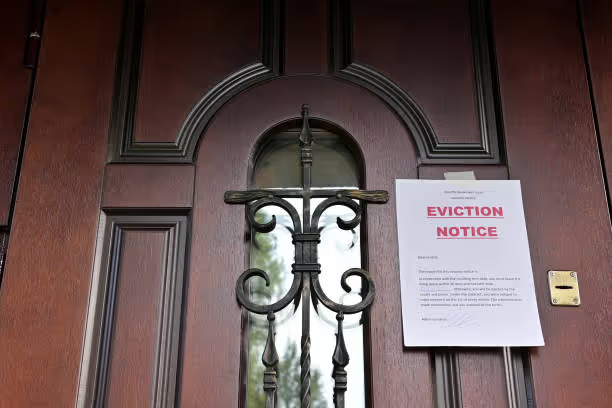
Evicting a tenant in Kansas means following forcible detainer action (statutorily titled "Evictions") in District Court exactly, start to finish. Skipping a step, whether it's the notice period, how the tenant is served, or the lockout procedure, can restart the clock or expose a management company to liability. This guide walks through each step with the statute or court rule behind it.
Everything below is sourced to Kansas's own statutes and court self-help pages. Specific deadlines and dollar figures do change, so confirm the current text before you rely on a date in a live case.
Overview Of The Eviction Process
Kansas evictions are governed procedurally by K.S.A. 61-3801 through 61-3808 (Chapter 61, Article 38, "Evictions"), filed in district court, with substantive lease-termination notice rules coming from the Kansas Residential Landlord and Tenant Act, K.S.A. 58-2540 et seq.
- Kansas Statutes Chapter 61, Article 38 is titled "Evictions" and contains the procedural sections governing notice to leave, the petition, summons, answer, trial, and the writ of restitution (K.S.A. 61-3801 to 61-3808). (K.S.A. 61-3801 to 61-3808 (Article 38 index))
- Substantive grounds and notice periods for terminating a residential tenancy (nonpayment, lease violations) are set out in the Kansas Residential Landlord and Tenant Act at K.S.A. 58-2564. (K.S.A. 58-2564)
Lawful Grounds For Eviction
Nonpayment of rent and material lease noncompliance are the statutory grounds addressed by the Residential Landlord and Tenant Act's termination-notice provisions.
- If rent is unpaid when due, the landlord may terminate after giving written notice of nonpayment and intent to terminate, and the tenant fails to pay within three consecutive 24-hour periods. (K.S.A. 58-2564(b))
- Material noncompliance with the rental agreement or a breach materially affecting health and safety allows termination if the tenant does not remedy the breach within 14 days after written notice. (K.S.A. 58-2564(a))
Notice Requirements
Kansas uses a two-step notice structure: a termination notice under the landlord-tenant act, followed by a separate three-day notice to leave before the eviction suit is filed.
- For nonpayment, the landlord's written notice must state the nonpayment and intent to terminate if rent is not paid within three consecutive 24-hour periods after the notice. (K.S.A. 58-2564(b))
- For a curable material breach, notice must specify the breach and state the rental agreement terminates not less than 30 days after receipt of the notice if the breach is not remedied within 14 days. (K.S.A. 58-2564(a))
- Before filing suit, a separate notice to leave the premises must be delivered at least three days before filing, by handing it to the other party, leaving it with a resident over age 12, posting it conspicuously on the premises, or mailing it; the three-day period is computed as three consecutive 24-hour periods, and mailing adds two more days before suit may be filed. (K.S.A. 61-3803)
Filing The Case
The eviction is commenced by petition describing the premises and the grounds for possession, filed in district court.
- The petition must describe the premises for which possession is sought and state why the plaintiff is seeking possession; if rent is due, the petition may include a claim for that amount, or the plaintiff may bring a separate suit for it. (K.S.A. 61-3804)
Serving The Tenant
After the petition is filed, the court issues a summons with an appearance date bounded by statute, in addition to the pre-filing notice to leave.
- The time stated in the summons for the defendant to appear is set by the court but must be not less than three nor more than 14 days after the summons is issued. (K.S.A. 61-3805)
- The pre-suit notice to leave the premises may be delivered by handing it to the party, leaving it with a resident over age 12, posting it conspicuously, or mailing it (with two additional days allowed when mailed). (K.S.A. 61-3803)
The Tenant's Response
The defendant must appear in person or through counsel by the date in the summons, or file a written answer by that date.
- A defendant must either appear in person or by counsel at the time and date in the summons, or file a written answer on or before that date, and the answer must contain the information required under K.S.A. 61-2904(b). (K.S.A. 61-3806)
Hearing And Judgment
If the case is not resolved by answer, it proceeds to trial, after which a judgment for possession leads to a writ of restitution.
- K.S.A. 61-3807, within the same eviction article, governs the trial of the eviction case following the defendant's appearance or answer. (K.S.A. 61-3807 ("Trial"))
- Once the court renders a judgment for possession, it issues a writ of restitution at the plaintiff's request, directing an officer to place the plaintiff back in possession. (K.S.A. 61-3808)
The Writ And Lockout
The writ of restitution is executed by a sheriff, constable, or marshal, who may use reasonable force, within a fixed window after receipt.
- The writ of restitution must be executed within 14 days of receipt, and the serving officer must file a return documenting the action. (K.S.A. 61-3808)
- The officer serving the writ may use such reasonable force as is necessary to execute it. (K.S.A. 61-3808)
- If the court notifies the officer that the proceedings have been stayed by appeal, the officer must halt execution immediately, and if possession was already delivered to the plaintiff, must restore possession to the defendant. (K.S.A. 61-3808)
Prohibited Practices
Self-help eviction, including unlawful removal, lockouts, and service interruptions, is banned, with a statutory damages remedy for the tenant.
- If the landlord unlawfully removes or excludes the tenant, or willfully diminishes services by interrupting electric, gas, water, or other essential service, the tenant may recover possession or terminate the rental agreement and recover an amount not more than one and one-half months' periodic rent or the tenant's actual damages, whichever is greater. (K.S.A. 58-2563)
Recent Changes Worth Tracking
- House Bill 2378, the "Removal of Squatters Act," was enacted in the 2025 session, creating a law-enforcement affidavit process for property owners to have true squatters (never tenants, never with any occupancy agreement) removed without a court eviction, excludes squatter occupancy from the Residential Landlord and Tenant Act, and creates criminal penalties for a false affidavit plus a civil cause of action, including attorney fees and punitive damages, for wrongful removal. (2025 Kan. Sess. Laws, House Bill 2378)
Eviction is the last step in a relationship that's already gone wrong. See our guide to Kansas property management laws and regulations for the licensing, disclosure, and trust-account rules that apply before it gets to this point.
Doing It By The Book
Self-help evictions, changing locks, removing doors, shutting off utilities, are illegal in every state and expose a management company to real liability regardless of how clear the nonpayment is. The court process exists because it's the only lawful way to remove a tenant, and skipping a step (a defective notice, bad service) is the single most common reason a case gets dismissed and restarted from day one.
This guide is a starting point for professional managers, not legal advice. For a specific case, a contested filing, or anything unusual, work with a Kansas attorney, and confirm the current text of any rule cited above with District Court or the Kansas legislature.
Sources
Every fact above is drawn from one of the official sources below.
- K.S.A. 61-3801 to 61-3808 (Article 38 index), Office of Revisor of Statutes, State of Kansas, Chapter 61 index
- K.S.A. 58-2564, Office of Revisor of Statutes, State of Kansas, K.S.A. 58-2564
- K.S.A. 61-3803, Office of Revisor of Statutes, State of Kansas, K.S.A. 61-3803
- K.S.A. 61-3804, Office of Revisor of Statutes, State of Kansas, K.S.A. 61-3804
- K.S.A. 61-3805, Office of Revisor of Statutes, State of Kansas, K.S.A. 61-3805
- K.S.A. 61-3806, Office of Revisor of Statutes, State of Kansas, K.S.A. 61-3806
- K.S.A. 61-3808, Office of Revisor of Statutes, State of Kansas, K.S.A. 61-3808
- K.S.A. 58-2563, Office of Revisor of Statutes, State of Kansas, K.S.A. 58-2563
- 2025 Kan. Sess. Laws, House Bill 2378, Kansas Legislature, HB 2378 bill status page
Frequently asked questions
Kansas evictions are governed procedurally by K.S.A. 61-3801 through 61-3808 (Chapter 61, Article 38, "Evictions"), filed in district court, with substantive lease-termination notice rules coming from the Kansas Residential Landlord and Tenant Act, K.S.A. 58-2540 et seq.
Kansas uses a two-step notice structure: a termination notice under the landlord-tenant act, followed by a separate three-day notice to leave before the eviction suit is filed.
Self-help eviction, including unlawful removal, lockouts, and service interruptions, is banned, with a statutory damages remedy for the tenant.
Managing rentals through an eviction?
An eviction lands on your books as well as your docket: the security deposit disposition, prorated or written-off rent, and the owner statement it all flows into. If you would rather have the accounting side handled while you handle the property, see how we keep trust accounts clean through move-outs, or find your state in our eviction process guides.