

Eviction Process In Iowa
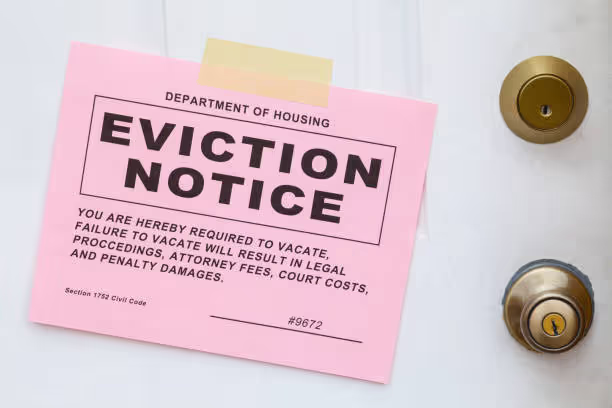
Evicting a tenant in Iowa means following forcible entry and detainer action in Iowa District Court (many residential cases proceed in the small claims division) exactly, start to finish. Skipping a step, whether it's the notice period, how the tenant is served, or the lockout procedure, can restart the clock or expose a management company to liability. This guide walks through each step with the statute or court rule behind it.
Everything below is sourced to Iowa's own statutes and court self-help pages. Specific deadlines and dollar figures do change, so confirm the current text before you rely on a date in a live case.
Overview Of The Eviction Process
Iowa's summary eviction remedy is the forcible entry and detainer (FED) action under Iowa Code chapter 648, heard in Iowa District Court. Nonpayment and holdover cases are commonly filed as small claims actions.
- An action for forcible entry and detainer is governed by Iowa Code chapter 648 and is tried as an equitable action in the district court for the county where all or part of the premises is located. (Iowa Code section 648.5(1)(a))
- The court must set the hearing no later than 8 days from the filing date, unless the plaintiff requests or consents to a later date, in which case the hearing must still be no later than 15 days from filing. (Iowa Code section 648.5(1)(a))
- An FED action generally cannot be joined with any other action, except a claim for rent or recovery under specified landlord-tenant statutes, and cannot be made the subject of a counterclaim. (Iowa Code section 648.19)
Lawful Grounds For Eviction
Iowa Code section 648.1 lists six specific grounds for a forcible entry and detainer action.
- Nonpayment of rent when due is a statutory ground for the action. (Iowa Code section 648.1(5))
- A lessee holding over after termination of the lease, or holding contrary to the terms of the lease, are separate statutory grounds. (Iowa Code section 648.1(2), (3))
- Forcible entry itself (entering another's actual possession by force, intimidation, fraud, or stealth and detaining it) is a distinct ground, and it is the one ground that does not require a prior notice to quit. (Iowa Code section 648.1(1); section 648.3(1))
- Continued possession after a foreclosure or execution sale (absent paramount title), and continued possession after issuance of a valid tax deed, are also statutory grounds. (Iowa Code section 648.1(4), (6))
Notice Requirements
A three-day notice to quit is required before filing on nearly every ground; nonpayment notices are also governed by the landlord-tenant chapter.
- Before an action can be brought on any ground under section 648.1 except forcible entry itself, three days' written notice to quit must be given to the defendant. (Iowa Code section 648.3(1))
- The notice to quit may be served by acknowledged delivery to an adult resident, personal service under Iowa Rule of Civil Procedure 1.305, or by posting on the primary entrance door plus mailing by both regular and certified mail. (Iowa Code section 648.3(2))
- A notice to quit served by mail is deemed completed four days after it is deposited in the mail and postmarked for delivery, whether or not the recipient signs for it. (Iowa Code section 648.3(3))
- For a tenancy at will based on nonpayment of rent, no separate notice terminating the tenancy is required beyond the three-day notice to quit. (Iowa Code section 648.4)
Filing The Case
The action is filed in the district court of the county where the premises are located; many residential cases are filed as small claims.
- Venue is the county where all or part of the premises is located; upon receipt of the petition the court sets a date, time, and place for hearing. (Iowa Code section 648.5(1)(a))
- If service of the original notice is made by posting and mailing, the plaintiff must file an affidavit describing the time and manner of posting and mailing, with copies of the posted and mailed documents attached, at or before the hearing. (Iowa Code section 648.5(4))
Serving The Tenant
Original notice may be served by acknowledged delivery, personal service, or (after two failed attempts) posting plus mailing, each with a minimum lead time before the hearing.
- Original notice may be served by delivery acknowledged and signed by an adult resident, which is invalid if signed less than three days before the hearing. (Iowa Code section 648.5(2)(a))
- Personal service under Iowa Rule of Civil Procedure 1.305 must not occur less than three days before the hearing. (Iowa Code section 648.5(2)(b))
- If two attempts at delivery or personal service fail, service may be made by posting on the primary entrance door plus mailing by regular and certified mail, posted and mailed not less than three days before the hearing. (Iowa Code section 648.5(2)(c))
- Service by mail is deemed complete four days after deposit in the mail and postmarking, regardless of whether the fourth day is a Saturday, Sunday, or federal holiday. (Iowa Code section 648.5(3))
The Tenant's Response
No default judgment may be entered without proper service, and the court must offer a continuance in certain short-notice situations.
- A default judgment cannot be entered against a defendant if original notice was not served as required; if the notice periods cannot be met, the court may set a new hearing date. (Iowa Code section 648.5(6))
- If the hearing is held fewer than three days after service, or if notice is deemed satisfied because the defendant appeared, the court must inform the defendant of the right to a continuance and must grant one on request to prepare or retain counsel. (Iowa Code section 648.5(5))
- At the hearing (except for cases filed as small claims), the court determines whether a genuine issue of material fact exists; if so, the matter is continued for an evidentiary hearing rather than decided summarily. (Iowa Code section 648.5(7))
Hearing And Judgment
Judgment orders removal of the defendant and restores possession to the plaintiff; a peaceable-possession statute of limitations also applies.
- The hearing must be set no later than 8 days from filing (or 15 days if the plaintiff requests or consents to the later date). (Iowa Code section 648.5(1)(a))
- If the defendant is found guilty, judgment is entered removing the defendant and placing the plaintiff in possession, and an execution for removal issues within three days of the judgment, along with a clause for collection of costs. (Iowa Code section 648.22)
- Thirty days' peaceable possession, with the plaintiff's knowledge, after the cause of action accrues bars the proceeding. (Iowa Code section 648.18)
The Writ And Lockout
The order for removal (execution) can only be executed during the day; manufactured/mobile homes have special extended-removal rules.
- The order for removal can be executed only in the daytime. (Iowa Code section 648.20)
- Execution for the defendant's removal issues within three days from judgment. (Iowa Code section 648.22)
- For manufactured or mobile homes, the plaintiff or defendant may elect (with conditions, including utility disconnection and notice to the sheriff, lienholders, and county treasurer) to leave the home on site for up to sixty days after judgment before it must be sold, removed, or disposed of. (Iowa Code section 648.22A)
Prohibited Practices
Self-help eviction, including unlawful ouster and utility shutoffs, is banned by the landlord-tenant chapter and carries actual, punitive, and attorney fee exposure.
- If a landlord unlawfully removes or excludes a tenant, or willfully diminishes services by interrupting electric, gas, water, or other essential service, the tenant may recover possession or terminate the rental agreement and, in either case, recover actual damages, punitive damages up to twice the monthly rent, and reasonable attorney fees. (Iowa Code section 562A.26)
- If the rental agreement is terminated due to the landlord's unlawful ouster or service interruption, the landlord must return all prepaid rent and security. (Iowa Code section 562A.26)
Eviction is the last step in a relationship that's already gone wrong. See our guide to Iowa property management laws and regulations for the licensing, disclosure, and trust-account rules that apply before it gets to this point.
Doing It By The Book
Self-help evictions, changing locks, removing doors, shutting off utilities, are illegal in every state and expose a management company to real liability regardless of how clear the nonpayment is. The court process exists because it's the only lawful way to remove a tenant, and skipping a step (a defective notice, bad service) is the single most common reason a case gets dismissed and restarted from day one.
This guide is a starting point for professional managers, not legal advice. For a specific case, a contested filing, or anything unusual, work with a Iowa attorney, and confirm the current text of any rule cited above with Iowa District Court (many residential cases proceed in the small claims division) or the Iowa legislature.
Sources
Every fact above is drawn from one of the official sources below.
- Iowa Code section 648.5(1)(a), Iowa Legislature, Iowa Code chapter 648 (Forcible Entry and Detainer)
- Iowa Code section 562A.26, Iowa Legislature, Iowa Code section 562A.26
Frequently asked questions
Iowa's summary eviction remedy is the forcible entry and detainer (FED) action under Iowa Code chapter 648, heard in Iowa District Court. Nonpayment and holdover cases are commonly filed as small claims actions.
A three-day notice to quit is required before filing on nearly every ground; nonpayment notices are also governed by the landlord-tenant chapter.
Self-help eviction, including unlawful ouster and utility shutoffs, is banned by the landlord-tenant chapter and carries actual, punitive, and attorney fee exposure.
Managing rentals through an eviction?
An eviction lands on your books as well as your docket: the security deposit disposition, prorated or written-off rent, and the owner statement it all flows into. If you would rather have the accounting side handled while you handle the property, see how we keep trust accounts clean through move-outs, or find your state in our eviction process guides.