

Eviction Process In Indiana
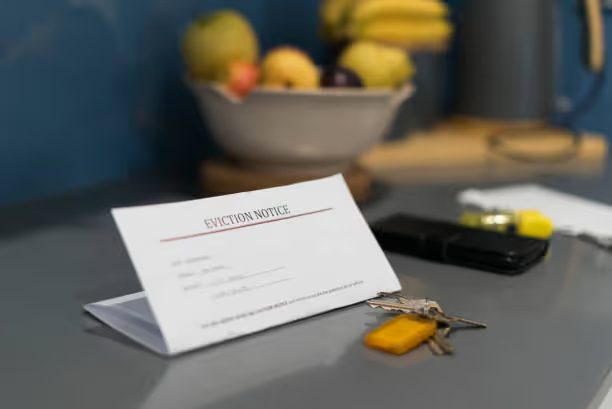
Evicting a tenant in Indiana means following Eviction action (a possessory action between landlord and tenant) in Small Claims Court (a docket of the county Circuit or Superior Court; Marion County has a separate Small Claims Court system under IC 33-34) exactly, start to finish. Skipping a step, whether it's the notice period, how the tenant is served, or the lockout procedure, can restart the clock or expose a management company to liability. This guide walks through each step with the statute or court rule behind it.
Everything below is sourced to Indiana's own statutes and court self-help pages. Specific deadlines and dollar figures do change, so confirm the current text before you rely on a date in a live case.
Overview Of The Eviction Process
Indiana residential evictions are filed as small claims possessory actions, heard by the small claims docket of the Circuit or Superior Court in the county where the rental property sits (Marion County uses its own township Small Claims Courts). The action is governed by the landlord-tenant provisions of Indiana Code Title 32, Article 31, and procedurally by the Indiana Small Claims Rules.
- Small claims courts have jurisdiction over 'Landlord and tenant disputes, if the rent due at the time of filing is Ten Thousand dollars ($10,000.00) or less' and over 'Emergency possessory actions between a landlord and tenant under I.C. 32-31-6.' (Small Claims Manual (2026), pp. 11-12)
- The Indiana Small Claims Rules 'apply to all small claims proceedings in all courts of the State of Indiana, including Marion County Small Claims Courts, having jurisdiction over small claims as defined by relevant Indiana statutes.' (Ind. Small Claims Rule 1(A))
- You 'may not use small claims court to take possession of real estate if the agreement is a land contract or seek a foreclosure action. These types of cases must be filed as a civil case in the proper Circuit or Superior Court,' rather than as a small claims eviction. (Small Claims Manual (2026), p. 12)
- Indiana's eviction-specific statutes on dismissal for non-prosecution and record sealing are codified at IC 32-31-10 and IC 32-31-11, which the courts' own guidance refers to collectively as the 'eviction action.' (IC 32-31-10-3; Small Claims Manual (2026), p. 40)
Lawful Grounds For Eviction
Ordinary evictions in Indiana follow the general notice-to-quit framework (most commonly nonpayment of rent or the end of a tenancy without renewal). Indiana also has a separate 'emergency possessory' track under IC 32-31-6 for narrower, urgent grounds; nonpayment does not qualify for that faster track.
- Notice to quit is not required in certain statutorily prescribed circumstances under IC 32-31-1-8; for example, 'if the rent has not been paid the landlord can ask the tenant to vacate without advance notice,' though sheriff-enforced removal still requires a prior court order. (IC 32-31-1-8)
- Under IC 32-31-6, a landlord may file a small claims action for emergency possessory relief 'if a tenant is committing or threatening to commit waste to the premises.' (IC 32-31-6)
- A landlord may also seek emergency possessory relief if 'a tenant or the tenant's guest has committed a crime that affects the health and safety of another tenant, the landlord, or an agent of the landlord.' (IC 32-31-6)
- Emergency possessory relief is likewise available if 'a tenant provided materially false information to the landlord with the intent to induce the landlord into leasing or giving possession of the rental unit to the tenant.' (IC 32-31-6)
- The emergency track is narrow: 'Non-payment of rent is NOT a basis for an emergency eviction proceeding' under IC 32-31-6, so rent arrears must proceed through the standard notice-and-file eviction process instead. (IC 32-31-6)
Notice Requirements
Absent a lease provision or a statutory exception, Indiana defaults to 30 days' written notice to end a month-to-month tenancy. IC 32-31-1-8 lists specific situations, including unpaid rent, where advance notice is not legally required, though a court order is still needed before the sheriff will remove anyone.
- 'Unless the lease terms provide otherwise, the general rule is that a month-to-month lease, written or oral, requires advance notice of a least 30 days for termination by either party.' (General notice rule; IC 32-31-1-8 (exceptions))
- 'There are certain statutorily prescribed circumstances (IC 32-31-1-8) where advance notice or notice to quit is not necessary,' including nonpayment of rent. (IC 32-31-1-8)
- Even where advance notice is not legally required, 'actual eviction with the sheriff's participation will require a prior court order' before a tenant can be physically removed. (Small Claims Manual guidance)
- If a landlord has previously accepted late rent, the landlord 'must give the tenant reasonable notice, preferably in writing, that in the future late payments will no longer be accepted and will be considered a breach' before treating a later late payment as a lease violation. (Landlord-tenant guidance)
Filing The Case
An eviction is commenced by filing a 'Notice of Claim' (the small claims equivalent of a complaint and summons) with the small claims docket, in the township or county where the rental property is located, and paying the filing fee.
- An action 'shall be commenced by the filing of an unverified notice of claim in a court of competent jurisdiction and by payment of the prescribed filing fee or filing an order waiving the filing fee.' (Ind. Small Claims Rule 2(A)(1))
- 'Proper venue of any claim between landlord and tenant, including but not limited to a claim for rent, possession of real estate, return of property, return of security deposit or for damages... shall be in the township where the real estate is located,' unless that township has no small claims court. (Ind. Small Claims Rule 12(A)(3))
- The Notice of Claim must state 'the place, date, and time when the parties are to appear,' a 'brief statement of the nature and amount of the claim,' and 'an instruction to the defendant that the defendant should bring to trial all documents in the possession of or under the control of the defendant concerning the claim.' (Ind. Small Claims Rule 2(B)(3), (4), (6))
- A landlord-tenant dispute may only be filed in small claims court 'if the rent due at the time of filing is Ten Thousand dollars ($10,000.00) or less'; larger claims must go to the plenary (regular civil) docket. (Small claims jurisdictional cap)
Serving The Tenant
The Notice of Claim itself serves as the summons. It can be served by certified mail, personal delivery, or by leaving it at the tenant's residence with a mailed follow-up copy, and must reach the tenant at least 10 days before the court date.
- 'For the purpose of service the notice of claim shall also be considered to be the summons. A copy of the notice of claim shall be served upon each defendant. Service may be made by sending a copy by certified mail with return receipt requested, or by delivering a copy to the defendant personally, or by leaving a copy at the defendant's dwelling house or usual place of abode.' (Ind. Small Claims Rule 3(A))
- 'Whenever service is made by leaving a copy at defendant's dwelling house or usual place of abode, the person making the service also shall send by first class mail a copy of the notice of claim to the last known address of the person being served.' (Ind. Small Claims Rule 3(A))
- 'Notice of the suit must be served upon the named Defendant at least ten (10) days before the parties are to appear in court.' (Service timing requirement)
- If the clerk or sheriff cannot locate or notify the defendant within that 10-day window, the plaintiff may either dismiss the suit or request a continuance and re-serve using an 'Alias Notice of Claim.' (Alias Notice of Claim procedure)
- In Marion County, the court may designate a township constable, deputies, or a court employee as bailiff to personally effect service, pursuant to Trial Rule 4.12, in addition to certified mail service. (Ind. Small Claims Rule 3(B)-(C))
The Tenant's Response
Indiana small claims practice does not require a tenant to file a written answer. Defenses are automatically at issue, and the tenant's main procedural deadlines are the 10-day window to demand a jury trial and, if applicable, filing any counterclaim before trial.
- 'All defenses shall be deemed at issue without responsive pleadings, but this provision shall not alter the burden of proof,' meaning no formal written answer is required of the tenant. (Ind. Small Claims Rule 4(A))
- 'The court may request that the defendant enter an appearance prior to trial. Such appearance may be made in person, by telephone or by mail but the fact that no appearance is entered by the defendant shall not be grounds for default judgment.' (Ind. Small Claims Rule 4(B))
- A defendant may request a jury trial 'by submitting a written request to the court within ten (10) days after receipt of the notice of claim'; failing to do so within 10 days waives the right to a jury trial. (Ind. Small Claims Rule 4(C))
- A tenant with a claim against the landlord may bring a counterclaim, but it must be received by the court 'within such time as will allow the court to mail a copy to the plaintiff and be received by the plaintiff at least seven (7) calendar days prior to the trial.' (Ind. Small Claims Rule 5(A))
Hearing And Judgment
Small claims eviction hearings are deliberately informal and fast, with the judge relying only on evidence presented at trial. Judgment covers the amount proven (such as unpaid rent and costs) and, where sought, possession; default judgment is available if the tenant fails to appear after proper service.
- 'The trial shall be informal, with the sole objective of dispensing speedy justice between the parties according to the rules of substantive law, and shall not be bound by the statutory provisions or rules of practice, procedure, pleadings or evidence except provisions relating to privileged communications and offers of compromise.' (Ind. Small Claims Rule 8(A))
- Before entering a default judgment against an absent tenant, the court must find under oath that service gave 'a reasonable probability that the defendant received such notice,' that the tenant is under no legal disability, that Servicemembers Civil Relief Act protections do not bar it, and that 'the plaintiff has a prima facie case.' (Ind. Small Claims Rule 10(B))
- 'All judgments shall be reduced to writing signed by the court, dated, entered in the Record of Judgments and Orders, and noted in the small claims judgment docket,' and 'the party recovering judgment shall also recover costs regardless of the amount.' (Ind. Small Claims Rule 11(A)-(B))
- A default judgment may be vacated 'within one year after entering' upon a showing of good cause; after that year passes, it can only be reversed through an independent action under Indiana Trial Rule 60(B). (Ind. Small Claims Rule 10(C))
The Writ And Lockout
Possession of the rental unit is enforced through an 'Order of Possession of Real Estate,' carried out by the sheriff under Indiana Trial Rule 70. The order has a limited shelf life: it must be requested within 30 days of judgment and expires 30 days after issuance.
- 'When any order or judgment is for the delivery of possession, the party in whose favor it is entered is entitled to a writ of execution, assistance or order directing the sheriff or other enforcement officer to deliver possession upon application to the clerk.' (Ind. Trial Rule 70)
- 'An order of possession of real estate shall not be issued if more than thirty (30) days have passed since the judgment was issued. Thereafter, a plaintiff seeking possession may do so by filing a new case.' (Ind. Small Claims Rule 16(A))
- 'An order of possession of real estate shall be effective for no more than thirty (30) consecutive days after its date of issue. The court shall indicate the specific date of expiration on the face of each order of possession.' (Ind. Small Claims Rule 16(B))
- Even when statutory notice is excused, 'actual eviction with the sheriff's participation will require a prior court order,' confirming the sheriff (not the landlord) carries out the physical removal. (Enforcement practice note)
Prohibited Practices
Indiana bars landlord self-help removals. Lockouts and utility shutoffs are permitted only after abandonment, illegal use of either can expose the landlord to punitive damages, and a tenant can seek emergency court relief if a landlord tries either tactic.
- 'Generally, utility shut-offs by the landlord are permitted only when the premises have been abandoned by the tenant and the utilities are in the landlord's name; lockouts are not permitted unless the tenant has abandoned the premises.' (Landlord self-help restrictions)
- 'Illegal lockouts or utility shut offs could result in a judgment for punitive damages against the landlord.' (Penalty for self-help eviction)
- 'Landlords cannot hold the tenants' personal property as security for unpaid rent UNLESS a court has found the property abandoned or the court permits the landlord to attach the property'; doing so otherwise is 'illegal conversion of another's property,' which 'is a crime and in a civil suit could result in punitive damages.' (Restriction on holding tenant property)
- Under IC 32-31-6, a tenant may file a small claims action for emergency possessory relief 'if a landlord has unlawfully interfered with the tenant's access on possession of the premises by, for example, changing locks or interrupting or shutting off utilities or other essential services.' (IC 32-31-6)
Recent Changes Worth Tracking
- Beginning July 1, 2025, some eviction cases can be sealed from public court records if the money judgment against the tenant has been satisfied, or if the case was dismissed, decided for the tenant, or a judgment against the tenant was overturned on appeal and at least seven years have passed since judgment; the tenant must petition the court where the case was pending and include their name, date of birth, current address, and the case number. (IC 32-31-11-3; IC 32-31-11-4)
- Effective January 1, 2025, Indiana Small Claims Rule 8(C) no longer requires a corporation, LLC, LLP, sole proprietorship, or partnership, such as a property management company filing an eviction, to be represented by an attorney in Small Claims Court, provided a designated full-time employee files the required certificate of compliance and affidavit. (Ind. Small Claims Rule 8(C))
Eviction is the last step in a relationship that's already gone wrong. See our guide to Indiana property management laws and regulations for the licensing, disclosure, and trust-account rules that apply before it gets to this point.
Doing It By The Book
Self-help evictions, changing locks, removing doors, shutting off utilities, are illegal in every state and expose a management company to real liability regardless of how clear the nonpayment is. The court process exists because it's the only lawful way to remove a tenant, and skipping a step (a defective notice, bad service) is the single most common reason a case gets dismissed and restarted from day one.
This guide is a starting point for professional managers, not legal advice. For a specific case, a contested filing, or anything unusual, work with a Indiana attorney, and confirm the current text of any rule cited above with Small Claims Court (a docket of the county Circuit or Superior Court; Marion County has a separate Small Claims Court system under IC 33-34) or the Indiana legislature.
Sources
Every fact above is drawn from one of the official sources below.
- Small Claims Manual (2026), pp. 11-12, Indiana Office of Court Services, Small Claims Manual
- Ind. Small Claims Rule 1(A), Indiana Small Claims Rules (effective January 1, 2025)
- Ind. Trial Rule 70, Indiana Rules of Trial Procedure, Rule 70
Frequently asked questions
Indiana residential evictions are filed as small claims possessory actions, heard by the small claims docket of the Circuit or Superior Court in the county where the rental property sits (Marion County uses its own township Small Claims Courts). The action is governed by the landlord-tenant provisions of Indiana Code Title 32, Article 31, and procedurally by the Indiana Small Claims Rules.
Absent a lease provision or a statutory exception, Indiana defaults to 30 days' written notice to end a month-to-month tenancy. IC 32-31-1-8 lists specific situations, including unpaid rent, where advance notice is not legally required, though a court order is still needed before the sheriff will remove anyone.
Indiana bars landlord self-help removals. Lockouts and utility shutoffs are permitted only after abandonment, illegal use of either can expose the landlord to punitive damages, and a tenant can seek emergency court relief if a landlord tries either tactic.
Managing rentals through an eviction?
An eviction lands on your books as well as your docket: the security deposit disposition, prorated or written-off rent, and the owner statement it all flows into. If you would rather have the accounting side handled while you handle the property, see how we keep trust accounts clean through move-outs, or find your state in our eviction process guides.