

Eviction Process In Alabama
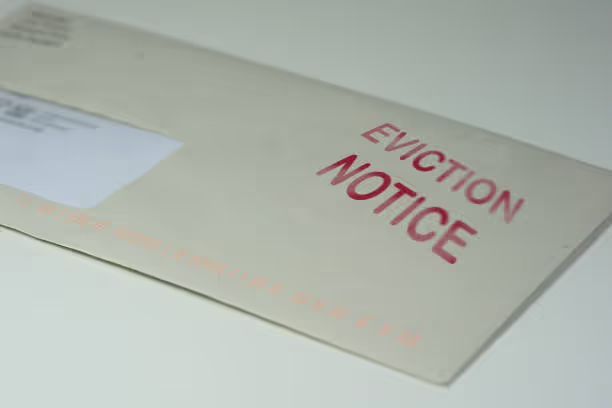
Evicting a tenant in Alabama means following Unlawful detainer action in District Court (Circuit Court has concurrent jurisdiction) exactly, start to finish. Skipping a step, whether it's the notice period, how the tenant is served, or the lockout procedure, can restart the clock or expose a management company to liability. This guide walks through each step with the statute or court rule behind it.
Everything below is sourced to Alabama's own statutes and court self-help pages. Specific deadlines and dollar figures do change, so confirm the current text before you rely on a date in a live case.
Overview Of The Eviction Process
Alabama residential evictions proceed as unlawful detainer actions under the Alabama Uniform Residential Landlord and Tenant Act (adopted by Act No. 2006-316, effective January 1, 2007). District Court and Circuit Court have concurrent jurisdiction, venue lies in the county where the leased property sits, and eviction actions get scheduling precedence over other civil cases.
- Unlawful detainer actions are Alabama's remedy for eviction in a landlord-tenant relationship, brought under the Alabama Uniform Residential Landlord and Tenant Act, effective January 1, 2007 (Act No. 2006-316). (Act No. 2006-316; Code of Alabama, Title 35)
- District Court and Circuit Court have concurrent jurisdiction over unlawful detainer actions; a request for injunctive relief must be filed in Circuit Court. (Ala. Code Title 35, Ch. 9A)
Lawful Grounds For Eviction
Grounds confirmed on the official court source are nonpayment of rent and other lease violations, each with its own notice-and-cure period before an unlawful detainer action may be filed.
- A landlord may pursue unlawful detainer for failure to pay rent, following the required notice period. (Ala. Code Title 35, Ch. 9A)
- A landlord may pursue unlawful detainer for lease violations other than nonpayment, after giving the tenant an opportunity to correct the violation. (Ala. Code Title 35, Ch. 9A)
Notice Requirements
The official Mobile County court page (13th Judicial Circuit) states a 7-day notice for nonpayment and a 14-day notice for other lease violations, each giving the tenant the right to cure before the landlord may file suit. A separate official source (Morgan County Sheriff) states the non-rent notice period as 30 days; the two official sources conflict on that second figure, so confirm which applies before serving notice.
- Seven days' written notice is required for failure to pay rent, and the notice must inform the tenant of the right to pay delinquent rent to cure. (Ala. Code Title 35, Ch. 9A)
- Fourteen days' written notice is required for lease violations other than nonpayment, per the Mobile County (13th Judicial Circuit) court page; the Morgan County Sheriff's Office page instead states this notice period as thirty days. Verify the current figure with the filing court before relying on either number. (Ala. Code Title 35, Ch. 9A)
- A copy of the notice to the tenant must accompany the unlawful detainer complaint when filed. (Ala. Code Title 35, Ch. 9A)
Filing The Case
The unlawful detainer complaint is filed on official Form C-59 in District or Circuit Court, with an initial filing fee of $350 plus $10 for each additional defendant.
- The unlawful detainer complaint is filed on official Form No. C-59, filed by a self-represented party or an attorney licensed in Alabama. (Form C-59 (AOC))
- The initial filing fee is $350.00, plus $10.00 for each additional defendant and a further fee for Sheriff service. (Form C-59 filing schedule (AOC))
Serving The Tenant
Possession claims require personal service, with posting-plus-mail as a fallback; money-damage claims follow the general civil service rule.
- Personal service is required for possession complaints; if personal service cannot be achieved, service may be made by posting on the premises with a copy mailed to the tenant by first-class mail. (Ala. R. Civ. P., referenced via unlawful detainer procedure)
- Claims for money damages are served under Alabama Rule of Civil Procedure 4 (certified mail or personal service). (Ala. R. Civ. P. 4)
The Tenant's Response
The tenant's answer is due in seven days for a possession claim, using the official PS-01 answer form.
- The tenant's answer to a possession complaint is due within seven days of service or posting. (Ala. Code Title 35, Ch. 9A)
- The answer to a money-damages claim in District Court is due within fourteen days. (Ala. Code Title 35, Ch. 9A)
- The official Answer to Landlord's Claim is Form PS-01. (Form PS-01 (revised 09/2021))
Hearing And Judgment
Failure to answer allows a default judgment and writ of possession; either side may appeal a District Court judgment to Circuit Court within seven days.
- If the tenant fails to answer, a default judgment and a writ of possession may be entered. (Ala. Code Title 35, Ch. 9A)
- A District Court judgment may be appealed to Circuit Court within seven consecutive days, and an appeal bond covering past-due and accruing rent, set by the judge, must be posted to stop eviction pending appeal. (Ala. Code Title 35, Ch. 9A)
- Appealed cases must be set for a Circuit Court hearing within 60 days. (Ala. Code Title 35, Ch. 9A)
The Writ And Lockout
The Writ of Possession carries a $17 filing fee and cannot be sought until the seven-day post-judgment/appeal window closes; the county Sheriff's Department carries out the physical eviction.
- A Writ of Possession may be filed for a $17.00 fee, but only after the post-judgment motion period and the seven-calendar-day appeal window have expired. (Ala. Code Title 35, Ch. 9A)
- The Sheriff's Department carries out the physical eviction once the Writ of Possession is filed and the waiting period has run. (Ala. Code Title 35, Ch. 9A)
Prohibited Practices
The official court process itself is the enforcement mechanism: a landlord must obtain a judgment and a Sheriff-executed Writ of Possession rather than removing a tenant directly.
- Removal of a tenant requires a court judgment followed by a Sheriff-executed Writ of Possession; the unlawful detainer statute does not authorize a landlord to retake possession on its own. (Ala. Code Title 35, Ch. 9A)
Eviction is the last step in a relationship that's already gone wrong. See our guide to Alabama property management laws and regulations for the licensing, disclosure, and trust-account rules that apply before it gets to this point.
Doing It By The Book
Self-help evictions, changing locks, removing doors, shutting off utilities, are illegal in every state and expose a management company to real liability regardless of how clear the nonpayment is. The court process exists because it's the only lawful way to remove a tenant, and skipping a step (a defective notice, bad service) is the single most common reason a case gets dismissed and restarted from day one.
This guide is a starting point for professional managers, not legal advice. For a specific case, a contested filing, or anything unusual, work with a Alabama attorney, and confirm the current text of any rule cited above with District Court (Circuit Court has concurrent jurisdiction) or the Alabama legislature.
Sources
Every fact above is drawn from one of the official sources below.
- Act No. 2006-316; Code of Alabama, Title 35, Alabama Unified Judicial System, 13th Judicial Circuit (Mobile County) official court site
- Form PS-01 (revised 09/2021), Alabama Administrative Office of Courts, AOC E-Forms
- Ala. Code Title 35, Ch. 9A, Morgan County Sheriff's Office, Alabama (official county government site)
Frequently asked questions
Alabama residential evictions proceed as unlawful detainer actions under the Alabama Uniform Residential Landlord and Tenant Act (adopted by Act No. 2006-316, effective January 1, 2007). District Court and Circuit Court have concurrent jurisdiction, venue lies in the county where the leased property sits, and eviction actions get scheduling precedence over other civil cases.
The official Mobile County court page (13th Judicial Circuit) states a 7-day notice for nonpayment and a 14-day notice for other lease violations, each giving the tenant the right to cure before the landlord may file suit. A separate official source (Morgan County Sheriff) states the non-rent notice period as 30 days; the two official sources conflict on that second figure, so confirm which applies before serving notice.
The official court process itself is the enforcement mechanism: a landlord must obtain a judgment and a Sheriff-executed Writ of Possession rather than removing a tenant directly.
Managing rentals through an eviction?
An eviction lands on your books as well as your docket: the security deposit disposition, prorated or written-off rent, and the owner statement it all flows into. If you would rather have the accounting side handled while you handle the property, see how we keep trust accounts clean through move-outs, or find your state in our eviction process guides.