

Eviction Process In Virginia
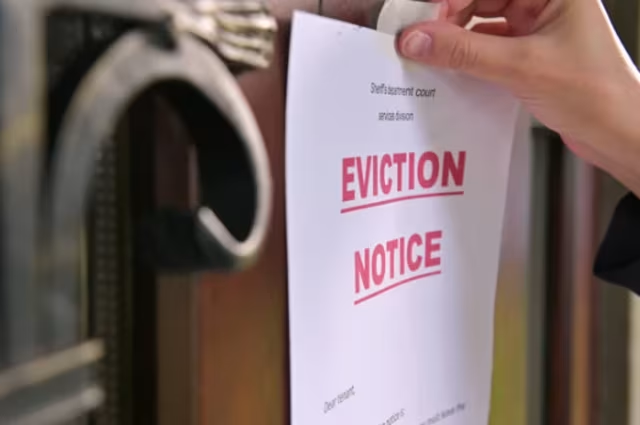
Evicting a tenant in Virginia means following unlawful detainer action in General District Court exactly, start to finish. Skipping a step, whether it's the notice period, how the tenant is served, or the lockout procedure, can restart the clock or expose a management company to liability. This guide walks through each step with the statute or court rule behind it.
Everything below is sourced to Virginia's own statutes and court self-help pages. Specific deadlines and dollar figures do change, so confirm the current text before you rely on a date in a live case.
Overview Of The Eviction Process
Virginia's summary eviction proceeding is the unlawful detainer action, heard in the General District Court of the county or city where the rental property is located. General procedure is set by Va. Code Title 8.01, Chapter 3, Article 13 (§§ 8.01-124 through 8.01-130.01), and for residential tenancies the Virginia Residential Landlord and Tenant Act, Va. Code § 55.1-1200 et seq., governs grounds and notice.
- Housing cases, including eviction (unlawful detainer), are heard in the General District Court. (Virginia Judicial System Court Self-Help, Landlord-Tenant page)
- A landlord, agent, or other person entitled to possession may present a sworn statement of facts to a magistrate, or a clerk or judge of a general district court, who then issues a summons for unlawful detainer against the person in possession. (Va. Code § 8.01-126)
- Where the summons is filed to terminate a residential tenancy, the initial hearing follows the procedures of the Virginia Residential Landlord and Tenant Act, Va. Code § 55.1-1200 et seq. (Va. Code § 8.01-126(D))
- Unlawful detainer covers both forcible or unlawful entry onto premises and unlawfully detaining possession after the right to possession has expired. (Va. Code § 8.01-124)
Lawful Grounds For Eviction
Lawful grounds recognized in the statutes reviewed are nonpayment of rent, material noncompliance with the lease or a health/safety violation, a repeated breach of like nature after a prior remedied breach, and unlawful/forcible entry or holdover after the right to possession has expired.
- Nonpayment of rent that is not paid within the statutory notice period is grounds for the landlord to terminate the rental agreement and seek possession. (Va. Code § 55.1-1245)
- Material noncompliance with the rental agreement, or a violation materially affecting health and safety, is grounds for termination if not remedied within the notice period. (Va. Code § 55.1-1245)
- A tenant's intentional commission of a subsequent breach of a like nature to a breach previously remedied is separate grounds for termination without a further cure opportunity. (Va. Code § 55.1-1245)
- Forcible or unlawful entry onto premises, or unlawfully detaining possession after the right to possession has expired without the owner's consent, is grounds for an unlawful detainer action. (Va. Code § 8.01-124)
Notice Requirements
Virginia's Residential Landlord and Tenant Act sets separate notice periods for nonpayment of rent and for other lease noncompliance.
- For nonpayment of rent, the landlord must serve written notice; if the tenant does not pay within 14 days after the notice is served, the landlord may terminate the rental agreement and seek possession. This 14-day period took effect July 1, 2026 (previously 5 days). (Va. Code § 55.1-1245)
- For a remediable material noncompliance, the written notice must specify the acts or omissions constituting the breach and state that the rental agreement terminates on a date not less than 30 days after receipt of the notice if the breach is not remedied within 21 days. (Va. Code § 55.1-1245)
- For a subsequent breach of a like nature to a breach the tenant previously remedied, the landlord's written notice must state that the rental agreement will terminate on a date not less than 30 days after receipt, with no cure period required. (Va. Code § 55.1-1245)
- The court may not enter an order of possession or judgment unless the landlord has presented the court a copy of a proper termination notice. (Va. Code § 8.01-126(D))
Filing The Case
The case is commenced in the General District Court where the property is located, using the official Summons for Unlawful Detainer.
- The official form to initiate the case is the Summons for Unlawful Detainer (Civil Claim for Eviction), Form DC-421. (Form DC-421)
- After judgment, the landlord requests removal using the Request for Writ of Eviction in Unlawful Detainer Proceedings, Form DC-469. (Form DC-469)
- For residential tenancies, the initial hearing on the summons must generally be held within 21 days from the date of filing, with a maximum of 30 days if delayed. (Va. Code § 8.01-126)
- For emergency cases involving a single-family residence with no written rental agreement, the hearing must be held within 14 days, with a maximum of 30 days. (Va. Code § 8.01-126)
Serving The Tenant
Service follows the general civil service statutes and must occur a minimum number of days before the return date.
- Process issued on an unlawful detainer summons may be served as provided in Va. Code §§ 8.01-293, 8.01-296, or 8.01-299. (Va. Code § 8.01-126)
- Service of the summons must be made at least 10 days before the return day. (Va. Code § 8.01-126)
The Tenant's Response
Virginia's unlawful detainer process does not use a separate written-answer deadline ahead of the hearing; the tenant's opportunity to respond is the hearing itself, held on the return date fixed by the summons.
- The tenant's opportunity to contest the case occurs at the hearing set on the summons return date, which for residential cases must be within 21 days of filing (30 days maximum if delayed). (Va. Code § 8.01-126)
Hearing And Judgment
The court hears the case at the return date and, if it finds for the landlord, enters judgment for possession; the judgment cannot issue without proof that a proper termination notice was given.
- Residential unlawful detainer hearings must generally occur within 21 days of filing, or up to 30 days if the hearing is delayed. (Va. Code § 8.01-126)
- The court may not enter an order of possession or judgment unless the landlord has presented a copy of a proper termination notice to the court. (Va. Code § 8.01-126(D))
The Writ And Lockout
Removal is carried out under a Writ of Eviction executed by the sheriff, subject to a notice period and the tenant's appeal window.
- Upon entry of judgment for possession, the judge may order that a writ of eviction issue immediately. (Va. Code § 8.01-129)
- The sheriff must serve notice of intent to execute the writ at least 72 hours before the eviction is carried out. (Va. Code § 8.01-129)
- The sheriff may not evict the tenant before the expiration of the defendant's 10-day appeal period. (Va. Code § 8.01-129)
Prohibited Practices
Self-help eviction is banned; a landlord may not force a tenant out by cutting off services or blocking access.
- A landlord may not recover or take possession of a dwelling unit by willful diminution of an essential service required by the rental agreement. (Va. Code § 55.1-1252)
- A landlord may not recover or take possession of a dwelling unit by refusing the tenant access to the unit, unless that refusal is pursuant to a court order for possession. (Va. Code § 55.1-1252)
Recent Changes Worth Tracking
- Effective July 1, 2026, the pay-or-quit notice period for nonpayment of rent under the Virginia Residential Landlord and Tenant Act was extended from 5 days to 14 days. (Va. Code § 55.1-1245)
Eviction is the last step in a relationship that's already gone wrong. See our guide to Virginia property management laws and regulations for the licensing, disclosure, and trust-account rules that apply before it gets to this point.
Doing It By The Book
Self-help evictions, changing locks, removing doors, shutting off utilities, are illegal in every state and expose a management company to real liability regardless of how clear the nonpayment is. The court process exists because it's the only lawful way to remove a tenant, and skipping a step (a defective notice, bad service) is the single most common reason a case gets dismissed and restarted from day one.
This guide is a starting point for professional managers, not legal advice. For a specific case, a contested filing, or anything unusual, work with a Virginia attorney, and confirm the current text of any rule cited above with General District Court or the Virginia legislature.
Sources
Every fact above is drawn from one of the official sources below.
- Virginia Judicial System Court Self-Help, Landlord-Tenant page, Virginia Judicial System Court Self-Help
- Va. Code § 8.01-126, Code of Virginia (Legislative Information System)
- Va. Code § 8.01-124, Code of Virginia (Legislative Information System)
- Va. Code § 55.1-1245, Code of Virginia (Legislative Information System)
- Form DC-421, Virginia Judicial System - District Court Forms
- Form DC-469, Virginia Judicial System - District Court Forms
- Va. Code § 55.1-1252, Code of Virginia (Legislative Information System)
Frequently asked questions
Virginia's summary eviction proceeding is the unlawful detainer action, heard in the General District Court of the county or city where the rental property is located. General procedure is set by Va. Code Title 8.01, Chapter 3, Article 13 (§§ 8.01-124 through 8.01-130.01), and for residential tenancies the Virginia Residential Landlord and Tenant Act, Va. Code § 55.1-1200 et seq., governs grounds and notice.
For nonpayment of rent, written notice giving the tenant 14 days to pay is required before termination (effective July 1, 2026; previously 5 days). For a remediable material noncompliance, the written notice must specify the breach and state that the agreement terminates on a date not less than 30 days after service.
Self-help eviction is banned; a landlord may not force a tenant out by cutting off services or blocking access.
Managing rentals through an eviction?
An eviction lands on your books as well as your docket: the security deposit disposition, prorated or written-off rent, and the owner statement it all flows into. If you would rather have the accounting side handled while you handle the property, see how we keep trust accounts clean through move-outs, or find your state in our eviction process guides.