

QuickBooks Online vs. Property Management Software — Do You Really Need Both?
QuickBooks Online vs. Property Management Software — Do You Really Need Both?
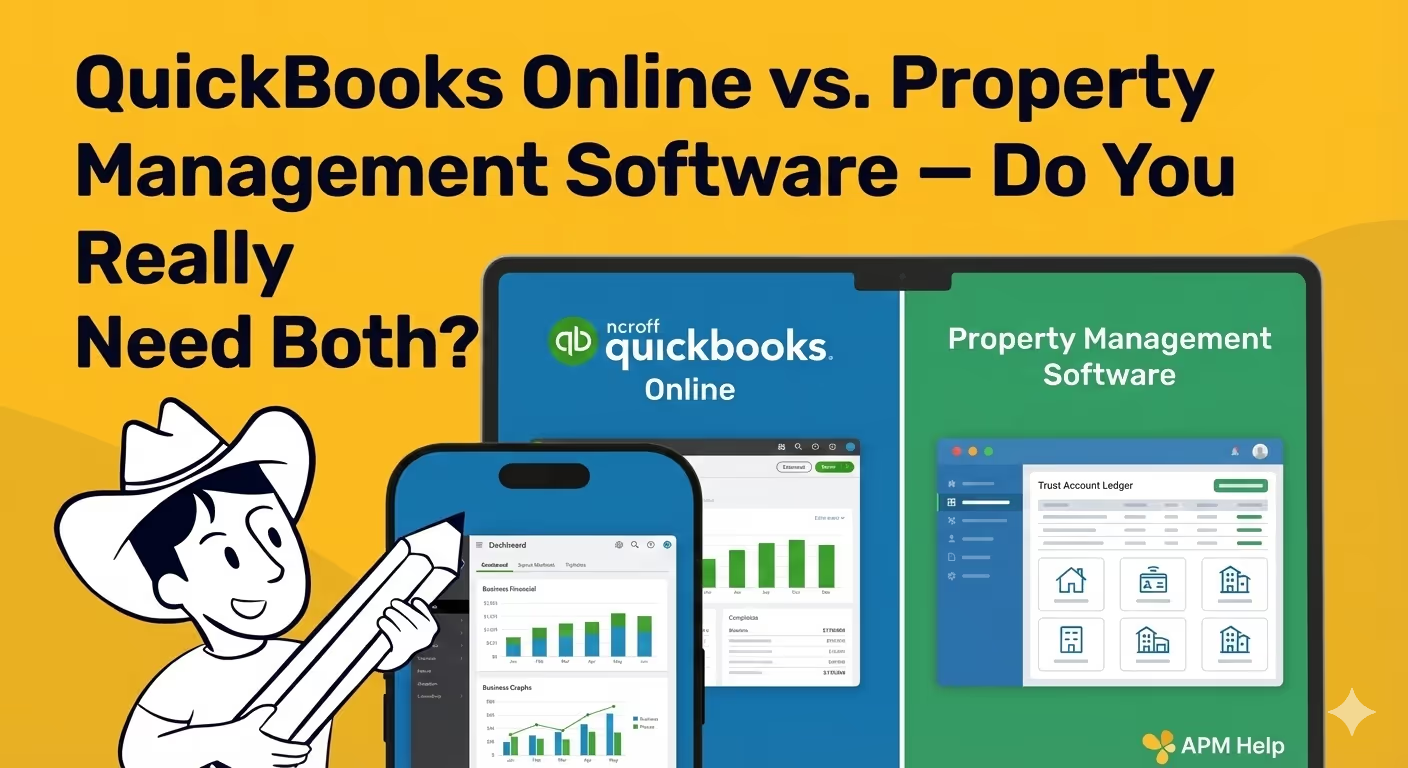
If you spend any time in property management circles, whether at conferences, industry forums, or Facebook groups, you know that accounting questions tend to spark the most passionate discussions. There’s a constant tug-of-war between operational efficiency, financial accuracy, and the desire to simplify your tech stack.
Recently, a question popped up on Facebook that perfectly captures the confusion many property managers feel as they scale. It seems simple on the surface, but beneath it lies the entire foundation of trust compliance and business accounting.
The question was:
“Is everyone using QuickBooks, or do you do all your accounting in your PMS?”
A fair question. Why pay for two systems? Why manage two sets of books? Isn’t one platform enough?
Our team jumped in with a response that resonated strongly with the community because it addressed what most people don’t know they’re missing.
Below is our full answer, followed by deeper insights that every property manager should understand.
The APM Help Expert Reply
“Company finances and trust bookkeeping are two entirely different sets of books—each requiring specialized features to stay accurate, current, operationally useful, and compliant with legal requirements.
For example, QuickBooks doesn’t have built-in trust accounting, while property management (PM) software does. Trying to force trust bookkeeping into QBO requires a highly complex setup and still makes it difficult to meet trust compliance standards or pass audits.
QBO also lacks essential PM tools like rental applications, lease-level ledgers, task management, online tenant portals, and other workflow-driven features.
On the other hand, PM software is heavily focused on trust compliance and property management workflows—meaning it misses many critical features needed for running the business side of a company.
QuickBooks offers far stronger business functionality, including reliable bank and credit card feed integrations with automated transaction coding, comprehensive financial reporting, accounts payable tracking (especially reimbursables), inventory tools, payroll, and more. PM software simply doesn’t match that flexibility.
To add to this, trying to bunch all your chart of accounts in one place can make things messy and confusing as well. A business chart of accounts is completely different from the chart of accounts for property operations.”
Deeper Insights
This is the part that often goes misunderstood until an audit letter arrives:
In property management, you’re running two distinct financial universes.
1. The Trust Side: The Property Books
This is other people’s money.
Your PMS (AppFolio, Buildium, Propertyware, Rentvine, etc.) is built specifically to manage:
Tenant and owner ledgers
Deposits and move-out accounting
Workflow-driven rent collection
Three-way reconciliation
Owner statements
Audit-ready trust compliance
Your PMS is designed so that a security deposit from Unit 201 can never accidentally pay a plumbing bill for Unit 309.
QuickBooks cannot enforce that separation.
2. The Business Side: Your Company’s Books
This is your money.
It includes:
Payroll
Office expenses
Tax reporting
Software costs
Marketing
Credit card feeds
Vendor reimbursements
Financial reporting
Your PMS is not designed to serve as your business accounting system. And if you try to make it one, you end up with inaccurate reporting and poor visibility into your company’s true financial health.
The Chart of Accounts Trap
This is where most accounting chaos begins.
When business transactions get mixed into your PMS—or trust transactions get forced into QuickBooks—your ledger becomes a cluttered, inaccurate mess.
You end up with things like:
Office Supplies mixed in with Owner Draws
Employee Lunches next to Tenant Utility Reimbursements
Marketing Spend buried between Recurring Owner Contributions
This doesn’t just break trust compliance—it kills your ability to understand your business.
Keeping each system dedicated to its purpose keeps your reporting:
Clean
Accurate
Compliant
Useful
Even once you understand the need for two systems, setting them up correctly is an entirely different challenge.
Mapping a chart of accounts
Building a PMS-to-QBO bridge
Ensuring trust compliance
Standardizing financial workflows
Cleaning historical data
Preparing for audits
Most property managers simply haven’t been trained for this level of accounting complexity. And they shouldn’t be—your job is managing properties, not decoding accounting systems.
This is where APM Help becomes invaluable.
APM Help is widely recognized as the industry’s most trusted source for PM bookkeeping and trust compliance. We don’t just give advice—we guarantee results.
Why property managers rely on us:
Guaranteed Trust Compliance
State trust rules vary, but our processes don’t miss. Ever.
100% Audit Pass Rate
Our clients walk into audits with confidence because their books are immaculate.
Benchmark-Level Operations
We set up your PMS and QuickBooks to run at peak industry standards.
Whether you’re untangling years of mixed books, setting up a new portfolio, or prepping for your first audit, APM Help is the partner that makes sure you’re always on solid ground.
Final Thought
Your accounting software should never dictate your workflow—or force you into compliance risk.
Use the right tool for each job:
PMS for trust accounting
QuickBooks for your business accounting
And let experts handle the complexity in between.

QuickBooks Online vs. Property Management Software — Do You Really Need Both?
If you spend any time in property management circles, whether at conferences, industry forums, or Facebook groups, you know that accounting questions tend to spark the most passionate discussions. There’s a constant tug-of-war between operational efficiency, financial accuracy, and the desire to simplify your tech stack.
Recently, a question popped up on Facebook that perfectly captures the confusion many property managers feel as they scale. It seems simple on the surface, but beneath it lies the entire foundation of trust compliance and business accounting.
The question was:
“Is everyone using QuickBooks, or do you do all your accounting in your PMS?”
A fair question. Why pay for two systems? Why manage two sets of books? Isn’t one platform enough?
Our team jumped in with a response that resonated strongly with the community because it addressed what most people don’t know they’re missing.
Below is our full answer, followed by deeper insights that every property manager should understand.
The APM Help Expert Reply
“Company finances and trust bookkeeping are two entirely different sets of books—each requiring specialized features to stay accurate, current, operationally useful, and compliant with legal requirements.
For example, QuickBooks doesn’t have built-in trust accounting, while property management (PM) software does. Trying to force trust bookkeeping into QBO requires a highly complex setup and still makes it difficult to meet trust compliance standards or pass audits.
QBO also lacks essential PM tools like rental applications, lease-level ledgers, task management, online tenant portals, and other workflow-driven features.
On the other hand, PM software is heavily focused on trust compliance and property management workflows—meaning it misses many critical features needed for running the business side of a company.
QuickBooks offers far stronger business functionality, including reliable bank and credit card feed integrations with automated transaction coding, comprehensive financial reporting, accounts payable tracking (especially reimbursables), inventory tools, payroll, and more. PM software simply doesn’t match that flexibility.
To add to this, trying to bunch all your chart of accounts in one place can make things messy and confusing as well. A business chart of accounts is completely different from the chart of accounts for property operations.”
Deeper Insights
This is the part that often goes misunderstood until an audit letter arrives:
In property management, you’re running two distinct financial universes.
1. The Trust Side: The Property Books
This is other people’s money.
Your PMS (AppFolio, Buildium, Propertyware, Rentvine, etc.) is built specifically to manage:
Tenant and owner ledgers
Deposits and move-out accounting
Workflow-driven rent collection
Three-way reconciliation
Owner statements
Audit-ready trust compliance
Your PMS is designed so that a security deposit from Unit 201 can never accidentally pay a plumbing bill for Unit 309.
QuickBooks cannot enforce that separation.
2. The Business Side: Your Company’s Books
This is your money.
It includes:
Payroll
Office expenses
Tax reporting
Software costs
Marketing
Credit card feeds
Vendor reimbursements
Financial reporting
Your PMS is not designed to serve as your business accounting system. And if you try to make it one, you end up with inaccurate reporting and poor visibility into your company’s true financial health.
The Chart of Accounts Trap
This is where most accounting chaos begins.
When business transactions get mixed into your PMS—or trust transactions get forced into QuickBooks—your ledger becomes a cluttered, inaccurate mess.
You end up with things like:
Office Supplies mixed in with Owner Draws
Employee Lunches next to Tenant Utility Reimbursements
Marketing Spend buried between Recurring Owner Contributions
This doesn’t just break trust compliance—it kills your ability to understand your business.
Keeping each system dedicated to its purpose keeps your reporting:
Clean
Accurate
Compliant
Useful
Even once you understand the need for two systems, setting them up correctly is an entirely different challenge.
Mapping a chart of accounts
Building a PMS-to-QBO bridge
Ensuring trust compliance
Standardizing financial workflows
Cleaning historical data
Preparing for audits
Most property managers simply haven’t been trained for this level of accounting complexity. And they shouldn’t be—your job is managing properties, not decoding accounting systems.
This is where APM Help becomes invaluable.
APM Help is widely recognized as the industry’s most trusted source for PM bookkeeping and trust compliance. We don’t just give advice—we guarantee results.
Why property managers rely on us:
Guaranteed Trust Compliance
State trust rules vary, but our processes don’t miss. Ever.
100% Audit Pass Rate
Our clients walk into audits with confidence because their books are immaculate.
Benchmark-Level Operations
We set up your PMS and QuickBooks to run at peak industry standards.
Whether you’re untangling years of mixed books, setting up a new portfolio, or prepping for your first audit, APM Help is the partner that makes sure you’re always on solid ground.
Final Thought
Your accounting software should never dictate your workflow—or force you into compliance risk.
Use the right tool for each job:
PMS for trust accounting
QuickBooks for your business accounting
And let experts handle the complexity in between.

Services Tailored for the best Property Managers.
Whether it's rental property management, bookkeeping support, training, bank reconciliations, or emergencies - we're here to help.

Financial & Books Cleanup
Get your books and financials cleaned up to be 100% audit proof.
Trust Bookkeeping
We keep your trust books clean, tidy, and up to date.

Corporate Bookkeeping
Don't worry, we also keep your corporate books clean as well!

And so much more...
We provide a large array of services to help power the best PMs out there.
