

Automation vs. Agentic Accounting: What’s the Difference (and Why It Matters)
Automation vs. Agentic Accounting: What’s the Difference (and Why It Matters)
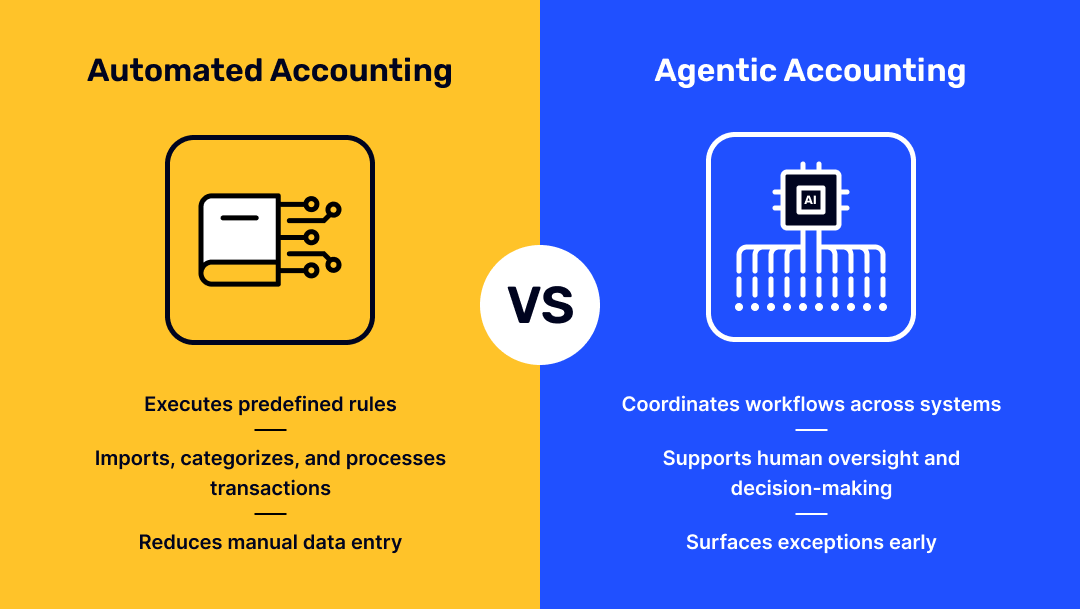
Automation has become a standard part of modern accounting. Most bookkeeping teams rely on software to import transactions, categorize activity, and generate reports. But as complexity increases, many firms are realizing that automation alone isn’t enough.
This is where the concept of agentic accounting enters the conversation.
What automated bookkeeping looks like today
Automated bookkeeping focuses on efficiency. Rules are created, transactions are processed automatically, and repetitive tasks are reduced. When done well, automation saves time and minimizes manual data entry.
However, automation is typically reactive. It follows predefined instructions and depends heavily on clean inputs and consistent conditions. When something unexpected happens, the system often stops and requires human intervention.
The limitations of automation alone
As businesses grow, their accounting becomes more complex. Multiple entities, trust accounts, compliance rules, and reporting requirements introduce scenarios that simple automation struggles to handle.
Automation on its own can lead to:
- Breakdowns when exceptions occur
- Increased manual review to catch errors
- Inconsistent results across portfoliosA
- Overreliance on rules that don’t scale
This is not a failure of automation — it’s a sign that accounting needs a more coordinated approach.
How agentic accounting builds on automation
Agentic accounting doesn’t replace automation; it builds on it.
While automation executes tasks, agentic systems are designed to coordinate workflows, surface exceptions earlier, and support human decision-making. Instead of isolated rules, processes work together to maintain accuracy and consistency.
In practice, this means fewer handoffs, better visibility into issues, and systems that support accountants rather than slow them down.
Why the distinction matters
Understanding the difference between automation and agentic accounting helps set realistic expectations. Fully autonomous accounting isn’t here yet — and responsible firms aren’t pretending it is.
What matters is direction. Firms that intentionally design processes around automation and workflow coordination are better positioned to handle growth, complexity, and compliance.
A thoughtful approach to the future
At APM Help, we view agentic accounting as the next stage in accounting’s evolution. We focus on building strong, automation-ready processes today so we can responsibly adopt more autonomous systems as the industry advances.
Automation is the foundation. Agentic accounting is the direction.

Automation vs. Agentic Accounting: What’s the Difference (and Why It Matters)
Automation has become a standard part of modern accounting. Most bookkeeping teams rely on software to import transactions, categorize activity, and generate reports. But as complexity increases, many firms are realizing that automation alone isn’t enough.
This is where the concept of agentic accounting enters the conversation.
What automated bookkeeping looks like today
Automated bookkeeping focuses on efficiency. Rules are created, transactions are processed automatically, and repetitive tasks are reduced. When done well, automation saves time and minimizes manual data entry.
However, automation is typically reactive. It follows predefined instructions and depends heavily on clean inputs and consistent conditions. When something unexpected happens, the system often stops and requires human intervention.
The limitations of automation alone
As businesses grow, their accounting becomes more complex. Multiple entities, trust accounts, compliance rules, and reporting requirements introduce scenarios that simple automation struggles to handle.
Automation on its own can lead to:
- Breakdowns when exceptions occur
- Increased manual review to catch errors
- Inconsistent results across portfoliosA
- Overreliance on rules that don’t scale
This is not a failure of automation — it’s a sign that accounting needs a more coordinated approach.
How agentic accounting builds on automation
Agentic accounting doesn’t replace automation; it builds on it.
While automation executes tasks, agentic systems are designed to coordinate workflows, surface exceptions earlier, and support human decision-making. Instead of isolated rules, processes work together to maintain accuracy and consistency.
In practice, this means fewer handoffs, better visibility into issues, and systems that support accountants rather than slow them down.
Why the distinction matters
Understanding the difference between automation and agentic accounting helps set realistic expectations. Fully autonomous accounting isn’t here yet — and responsible firms aren’t pretending it is.
What matters is direction. Firms that intentionally design processes around automation and workflow coordination are better positioned to handle growth, complexity, and compliance.
A thoughtful approach to the future
At APM Help, we view agentic accounting as the next stage in accounting’s evolution. We focus on building strong, automation-ready processes today so we can responsibly adopt more autonomous systems as the industry advances.
Automation is the foundation. Agentic accounting is the direction.

Services Tailored for the best Property Managers.
Whether it's rental property management, bookkeeping support, training, bank reconciliations, or emergencies - we're here to help.

Financial & Books Cleanup
Get your books and financials cleaned up to be 100% audit proof.

Trust Bookkeeping
We keep your trust books clean, tidy, and up to date.

Corporate Bookkeeping
Don't worry, we also keep your corporate books clean as well!

And so much more...
We provide a large array of services to help power the best PMs out there.
